
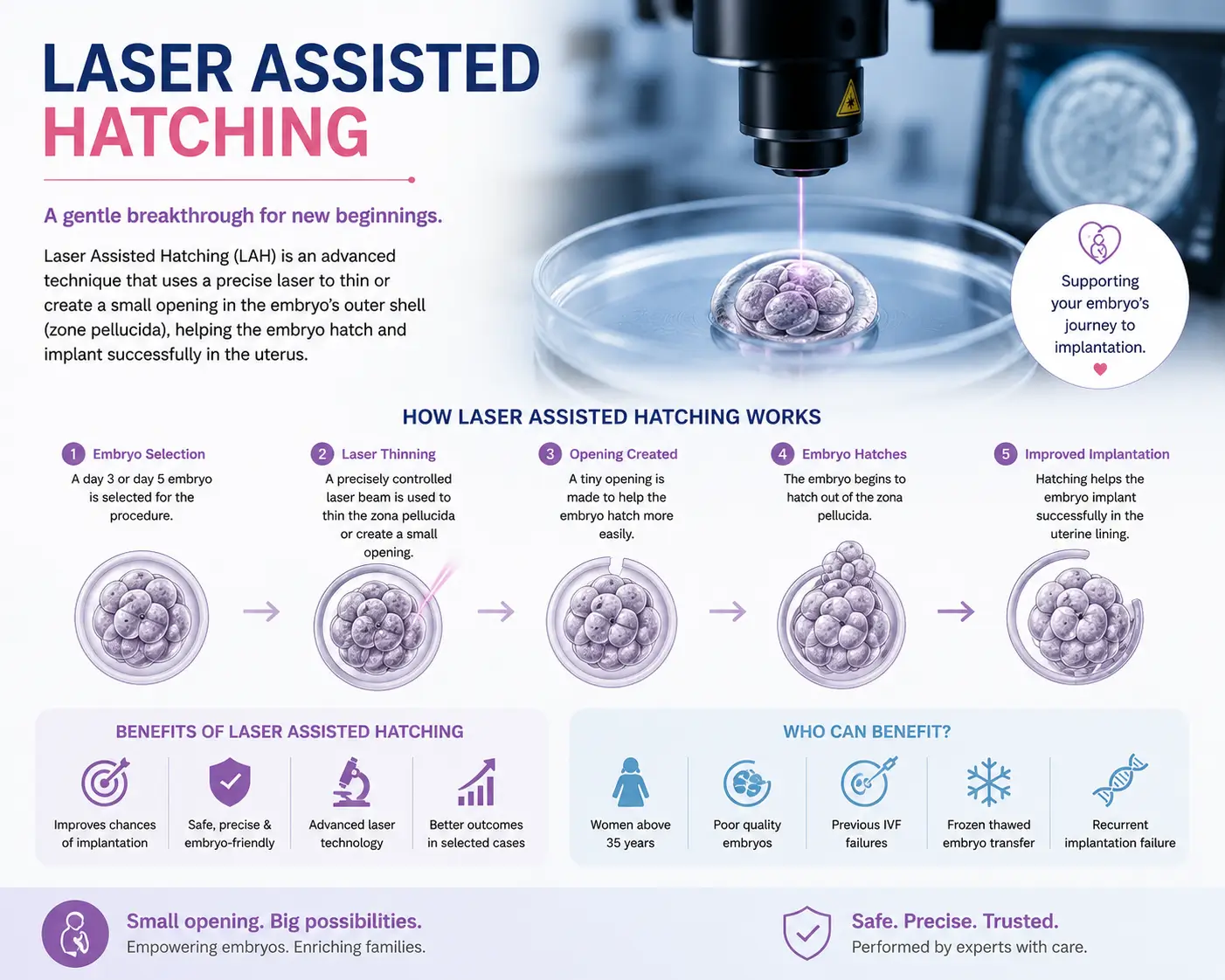
Laser Assisted Hatching
When you're undergoing IVF treatment, creating healthy embryos is only one part of the journey. For a pregnancy to occur, the embryo must successfully implant into the lining of the uterus. Sometimes, even good-quality embryos may struggle to implant despite a well-planned IVF cycle.
This is where Laser Assisted Hatching may play a role.
Laser Assisted Hatching is an advanced IVF technique that can help certain embryos break through their outer shell more easily before implantation. For selected patients, this additional laboratory procedure may improve the chances of embryo implantation and pregnancy.
Dr. Shipra Singla carefully evaluates each patient's fertility history, embryo development, and treatment outcomes before recommending Laser Assisted Hatching. Like all fertility treatments, it is not necessary for everyone, but in the right circumstances, it may provide an additional advantage during IVF.
What is Laser Assisted Hatching?
Every embryo is surrounded by a protective outer layer called the zona pellucida. In a natural pregnancy, the embryo must break free from this shell—a process known as "hatching"—before it can attach to the uterine lining and begin implantation.
Sometimes, the zona pellucida may become thicker or harder than usual, making it more difficult for the embryo to hatch on its own.
Laser Assisted Hatching is a specialized laboratory procedure in which a highly precise laser is used to create a tiny opening or thinning in the embryo's outer shell. This may help the embryo hatch more easily and potentially improve implantation.
The procedure is performed by experienced embryologists in the IVF laboratory and does not involve any additional discomfort for the patient.
Why is Hatching Important for Pregnancy?
Many patients are surprised to learn that even healthy embryos need to complete several important steps before pregnancy can occur.
After embryo transfer, the embryo must:
- Continue developing
- Reach the appropriate stage of growth
- Hatch from the zona pellucida
- Attach to the uterine lining
- Successfully implant
If hatching does not occur properly, implantation may be less likely, even when embryo quality appears good.
Laser Assisted Hatching is designed to support this critical stage of embryo development.
When Does Dr. Shipra Singla Recommend Laser Assisted Hatching?
Not every IVF patient requires Laser Assisted Hatching.
Dr. Shipra Singla may recommend this technique in specific situations where implantation challenges are more likely.
Laser Assisted Hatching may be considered for:
- Previous failed IVF cycles
- Repeated implantation failure
- Women of advanced maternal age
- Frozen embryo transfer cycles
- Embryos with a thicker zona pellucida
- Patients with a history of poor embryo implantation
- Cases where embryo hatching may be a concern
The decision is always based on individual fertility factors, embryo characteristics, and previous treatment history.
How Does Laser Assisted Hatching Work?
One of the reasons patients feel comfortable with this procedure is that it takes place entirely within the IVF laboratory.
Step 1: Embryo Evaluation
Before embryo transfer, embryologists carefully assess embryo quality and development.
The thickness and appearance of the embryo's outer shell may also be evaluated.
Step 2: Laser Application
Using advanced microscopic technology, a highly controlled laser creates a tiny opening or thins a small section of the zona pellucida.
The procedure is extremely precise and takes only a few seconds.
Step 3: Embryo Transfer
Once the process is completed, the embryo is prepared for transfer according to the planned IVF treatment cycle.
The goal is to help the embryo hatch more naturally after transfer and improve the opportunity for implantation.
Benefits of Laser Assisted Hatching
Laser Assisted Hatching has become a valuable tool in modern reproductive medicine because it may help selected patients overcome implantation challenges.
Supports Embryo Implantation
By assisting the embryo in breaking through its outer shell, the procedure may improve its ability to attach to the uterine lining.
Helpful After Previous IVF Failures
Patients who have experienced unsuccessful IVF cycles may benefit from additional implantation support.
Useful in Frozen Embryo Transfers
The freezing and thawing process can sometimes affect the embryo's outer shell. Assisted hatching may help address this issue in selected cases.
Advanced Laboratory Precision
Modern laser technology allows embryologists to perform the procedure with exceptional accuracy and control.
Personalized Fertility Care
The procedure can be incorporated into an individualized IVF treatment plan when clinically appropriate.
Who May Benefit Most from Laser Assisted Hatching?
Although every fertility journey is unique, some patients may be more likely to benefit from this technique.
Potential candidates include:
- Women over 35 years of age
- Patients with recurrent IVF failure
- Couples with repeated implantation failure
- Patients undergoing frozen embryo transfer
- Individuals with embryos showing a thick zona pellucida
- Patients with unexplained IVF implantation difficulties
During your consultation, Dr. Shipra Singla will determine whether Laser Assisted Hatching may be beneficial based on your specific fertility profile.
Laser Assisted Hatching and Frozen Embryo Transfer
Many patients undergoing Frozen Embryo Transfer (FET) ask whether assisted hatching is necessary.
While it is not required in every case, some fertility specialists may recommend Laser Assisted Hatching because frozen embryos occasionally develop a harder outer shell after thawing.
In selected situations, assisted hatching may support implantation and improve treatment outcomes.
The decision depends on embryo quality, patient age, previous treatment history, and other fertility factors.
Is Laser Assisted Hatching Safe?
Laser Assisted Hatching has been used in fertility laboratories around the world for many years.
The procedure is:
- Minimally invasive
- Performed under highly controlled laboratory conditions
- Completed using advanced microscopic equipment
- Carried out by trained embryologists
- Integrated into established IVF protocols when appropriate
As with any fertility treatment, recommendations are made only after careful evaluation of potential benefits and individual patient circumstances.
Does Laser Assisted Hatching Guarantee Pregnancy?
This is one of the most common questions patients ask.
While Laser Assisted Hatching may improve implantation opportunities in selected cases, no fertility treatment can guarantee pregnancy.
Successful implantation depends on many factors, including:
- Embryo quality
- Maternal age
- Egg quality
- Sperm quality
- Uterine health
- Hormonal balance
- Overall reproductive health
Laser Assisted Hatching is simply one of several advanced techniques that may help optimize IVF outcomes when used appropriately.
Dr. Shipra Singla's Approach to Advanced IVF Techniques
Every patient deserves a treatment plan that is tailored to their unique fertility needs.
Dr. Shipra Singla believes in using advanced reproductive technologies only when they offer meaningful potential benefits for the patient.
Her approach includes:
- Thorough fertility assessment
- Personalized IVF treatment planning
- Evidence-based fertility care
- Advanced embryology techniques
- Careful embryo evaluation
- Transparent communication
- Compassionate support throughout treatment
Rather than applying the same treatment to every patient, recommendations are customized based on individual fertility factors and treatment goals.
Frequently Asked Questions About Laser Assisted Hatching
Does Laser Assisted Hatching hurt?
No. The procedure is performed on the embryo in the laboratory and does not cause any discomfort to the patient.
Is Laser Assisted Hatching necessary for every IVF cycle?
No. It is recommended only in specific situations where it may improve implantation potential.
Can Laser Assisted Hatching improve IVF success rates?
For selected patients, especially those with previous IVF failures or implantation challenges, it may help improve implantation opportunities.
Is Laser Assisted Hatching used with frozen embryos?
Yes. It is sometimes recommended during frozen embryo transfer cycles depending on embryo characteristics and treatment history.
How long does the procedure take?
The laser procedure itself takes only a few seconds and is performed as part of the laboratory preparation before embryo transfer.
Take the Next Step Toward Parenthood
If you've experienced failed IVF cycles, implantation difficulties, or would like to learn more about advanced fertility techniques, expert guidance can help you understand which options may be right for you.
Schedule a consultation with Dr. Shipra Singla today to discuss your fertility journey, explore personalized treatment options, and discover whether Laser Assisted Hatching could play a role in your IVF success.
Because sometimes even the smallest scientific advancements can help create life-changing possibilities on the path to parenthood.