
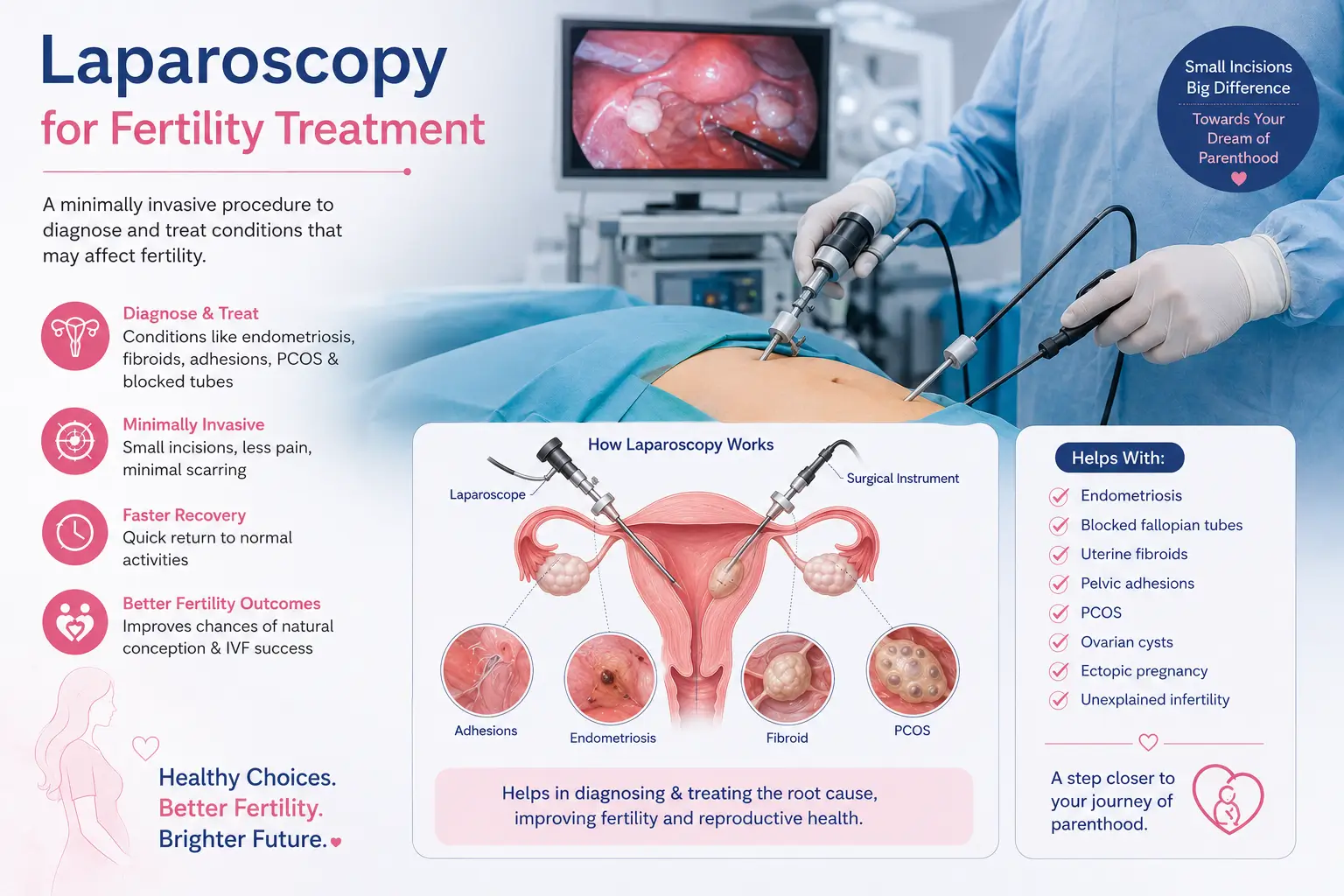
Laparoscopy for Fertility Treatment
When you're trying to conceive, identifying the exact cause of fertility challenges is often the first step toward successful treatment. While blood tests, ultrasounds, and fertility evaluations provide valuable information, some conditions affecting fertility can only be accurately diagnosed and treated through direct visualization of the reproductive organs.
This is where Laparoscopy plays an important role.
Laparoscopy is a minimally invasive surgical procedure that allows fertility specialists to examine the uterus, fallopian tubes, ovaries, and surrounding pelvic organs in detail. It not only helps diagnose fertility-related conditions but can also treat many of them during the same procedure.
Dr. Shipra Singla uses laparoscopy as part of a comprehensive fertility care approach to identify and manage conditions that may interfere with natural conception, IUI success, or IVF outcomes.
What is Laparoscopy?
Laparoscopy is a minimally invasive surgical procedure performed using a thin camera called a laparoscope.
A small incision is made near the abdomen, and the laparoscope is inserted to provide a clear view of the pelvic and reproductive organs.
This allows the fertility specialist to examine:
- Ovaries
- Fallopian tubes
- Uterus
- Pelvic cavity
- Surrounding reproductive structures
Unlike traditional open surgery, laparoscopy requires only small incisions, resulting in less discomfort and faster recovery.
Why is Laparoscopy Important in Fertility Treatment?
Many fertility problems cannot always be detected through routine scans or blood tests alone.
Conditions such as endometriosis, pelvic adhesions, tubal damage, and certain ovarian abnormalities may require direct visualization for accurate diagnosis.
Laparoscopy helps:
- Identify hidden causes of infertility
- Evaluate reproductive organ health
- Confirm diagnoses
- Treat fertility-related conditions
- Improve the chances of natural conception or assisted reproduction
For many patients, laparoscopy provides important answers when fertility challenges remain unexplained.
When Does Dr. Shipra Singla Recommend Laparoscopy?
Laparoscopy may be recommended if you are experiencing:
Unexplained Infertility
When standard fertility tests appear normal but pregnancy has not occurred, laparoscopy may help uncover hidden reproductive issues.
Endometriosis Symptoms
Women experiencing painful periods, pelvic pain, or infertility may benefit from laparoscopic evaluation for endometriosis.
Blocked Fallopian Tubes
Laparoscopy can help assess tubal health and determine whether treatment is possible.
Recurrent Pregnancy Loss
In some cases, pelvic abnormalities affecting fertility may contribute to pregnancy complications.
Pelvic Pain
Chronic pelvic discomfort may indicate reproductive conditions that require further evaluation.
Ovarian Cysts or Pelvic Masses
Laparoscopy can help diagnose and treat certain ovarian conditions affecting fertility.
Prior Failed Fertility Treatments
For patients who have undergone unsuccessful IUI or IVF cycles, laparoscopy may help identify previously undetected fertility issues.
Conditions Diagnosed Through Laparoscopy
One of the greatest advantages of laparoscopy is its ability to accurately diagnose fertility-related conditions.
Endometriosis
Endometriosis is one of the most common causes of female infertility.
It occurs when tissue similar to the uterine lining grows outside the uterus, affecting:
- Ovaries
- Fallopian tubes
- Pelvic organs
Endometriosis can cause:
- Painful periods
- Chronic pelvic pain
- Difficulty conceiving
- Implantation challenges
Laparoscopy is considered the gold standard for diagnosing endometriosis.
Blocked Fallopian Tubes
Healthy fallopian tubes are essential for natural conception.
Laparoscopy allows specialists to assess:
- Tubal patency
- Tubal damage
- Hydrosalpinx (fluid-filled tubes)
- Adhesions around the tubes
This information helps determine the most appropriate fertility treatment.
Pelvic Adhesions
Scar tissue within the pelvis can develop due to:
- Previous surgeries
- Infections
- Endometriosis
- Inflammatory conditions
Adhesions may interfere with egg release, fertilization, and embryo transport.
Laparoscopy can identify and remove these adhesions.
Ovarian Cysts
Certain ovarian cysts may impact fertility.
Laparoscopy helps evaluate:
- Endometriomas
- Persistent ovarian cysts
- Complex ovarian masses
Treatment can often be performed during the same procedure.
Fibroids Affecting Fertility
Some fibroids may alter reproductive anatomy and affect fertility outcomes.
Laparoscopy helps assess fibroid size, location, and impact on fertility.
Operative Laparoscopy: Treating Fertility Problems
In many cases, treatment can be performed immediately once the problem is identified.
This is known as Operative Laparoscopy.
Endometriosis Treatment
Endometriosis lesions can often be removed or treated during laparoscopy.
This may help:
- Improve fertility
- Reduce pain
- Enhance reproductive outcomes
Removal of Pelvic Adhesions
Scar tissue can be carefully separated to restore normal pelvic anatomy and improve reproductive function.
Ovarian Cyst Removal
Problematic ovarian cysts can often be removed while preserving healthy ovarian tissue whenever possible.
Treatment of Hydrosalpinx
A hydrosalpinx can negatively affect fertility and IVF success rates.
Laparoscopic treatment may improve future pregnancy outcomes in selected patients.
Fibroid Surgery
Certain fertility-impacting fibroids may be removed laparoscopically depending on their location and size.
How Laparoscopy Helps Improve Fertility
Laparoscopy can improve fertility by addressing conditions that interfere with conception.
Potential benefits include:
Restoring Normal Reproductive Anatomy
Treating adhesions, cysts, or tubal issues may improve natural fertility.
Improving Egg Pickup by the Fallopian Tubes
Pelvic anatomy can be optimized for natural fertilization.
Enhancing Implantation Potential
Treating reproductive abnormalities may improve the uterine and pelvic environment.
Increasing IVF Success
Removing conditions such as hydrosalpinx or severe endometriosis may improve IVF outcomes.
Reducing Pelvic Inflammation
Treating endometriosis and related conditions may support reproductive health.
Laparoscopy and IVF Treatment
Many patients wonder whether laparoscopy is necessary before IVF.
The answer depends on the individual's fertility diagnosis.
Dr. Shipra Singla may recommend laparoscopy before IVF when there is evidence of:
- Endometriosis
- Hydrosalpinx
- Pelvic adhesions
- Ovarian cysts
- Tubal disease
- Unexplained infertility
Treating these conditions before IVF may improve implantation rates and overall treatment success in selected patients.
What Happens During the Procedure?
Step 1: Anesthesia
Laparoscopy is performed under general anesthesia.
Step 2: Small Incisions
Small incisions are made in the abdomen.
Step 3: Camera Examination
A laparoscope is inserted to visualize the reproductive organs.
Step 4: Treatment (If Needed)
Any abnormalities identified can often be treated during the same procedure.
Step 5: Recovery
Most patients return home the same day or shortly after surgery, depending on the complexity of the procedure.
Benefits of Laparoscopy
Accurate Diagnosis
Provides a detailed view of reproductive organs.
Minimally Invasive
Requires only small incisions.
Simultaneous Diagnosis and Treatment
Many fertility issues can be diagnosed and corrected during one procedure.
Faster Recovery
Recovery is generally quicker compared to traditional open surgery.
Improved Fertility Outcomes
Treating fertility-related conditions may improve both natural conception and assisted reproduction success rates.
Is Laparoscopy Safe?
Laparoscopy is a commonly performed and well-established fertility procedure.
Like any surgical treatment, it carries potential risks and benefits, which are carefully discussed before treatment.
Dr. Shipra Singla recommends laparoscopy only when it is likely to provide meaningful diagnostic or therapeutic value based on a patient's fertility history and evaluation.
Dr. Shipra Singla's Approach to Fertility Surgery
Successful fertility treatment often requires identifying the root cause of infertility rather than simply treating symptoms.
Dr. Shipra Singla combines advanced diagnostic expertise with minimally invasive surgical techniques to help patients overcome fertility challenges and improve their chances of pregnancy.
Her approach includes:
- Comprehensive fertility assessment
- Advanced diagnostic evaluation
- Personalized treatment planning
- Fertility-preserving surgical techniques
- IVF and IUI treatment support
- Evidence-based reproductive care
- Compassionate patient guidance
Every treatment plan is designed around the patient's individual fertility goals and medical needs.
Frequently Asked Questions About Laparoscopy
Is laparoscopy painful?
The procedure is performed under general anesthesia, so patients do not feel pain during surgery. Mild discomfort during recovery is usually temporary.
How long does laparoscopy take?
The duration depends on type of treatment performed.
Can laparoscopy improve fertility?
Yes. In many cases, treating conditions such as endometriosis, adhesions, blocked tubes, or ovarian cysts may improve fertility outcomes.
Will I need IVF after laparoscopy?
Not necessarily. Some patients conceive naturally after treatment, while others may still benefit from IUI or IVF depending on their fertility condition.
How soon can I try to conceive after laparoscopy?
This varies based on the findings and treatment performed. Dr. Shipra Singla will provide individualized recommendations.
Take the Next Step Toward Parenthood
If you're struggling with infertility, pelvic pain, endometriosis, recurrent fertility treatment failures, or unexplained difficulty conceiving, laparoscopy may provide the answers you've been searching for.
Schedule a consultation with Dr. Shipra Singla today to discuss whether laparoscopy could help improve your fertility. Through advanced diagnostic evaluation, minimally invasive surgical expertise, and personalized fertility care, she can help identify and address the conditions that may be standing between you and a successful pregnancy.
Sometimes the key to successful conception lies in finding and treating what cannot be seen through routine testing. Laparoscopy can uncover hidden fertility challenges, improve reproductive health, and bring you one step closer to achieving your dream of parenthood.