
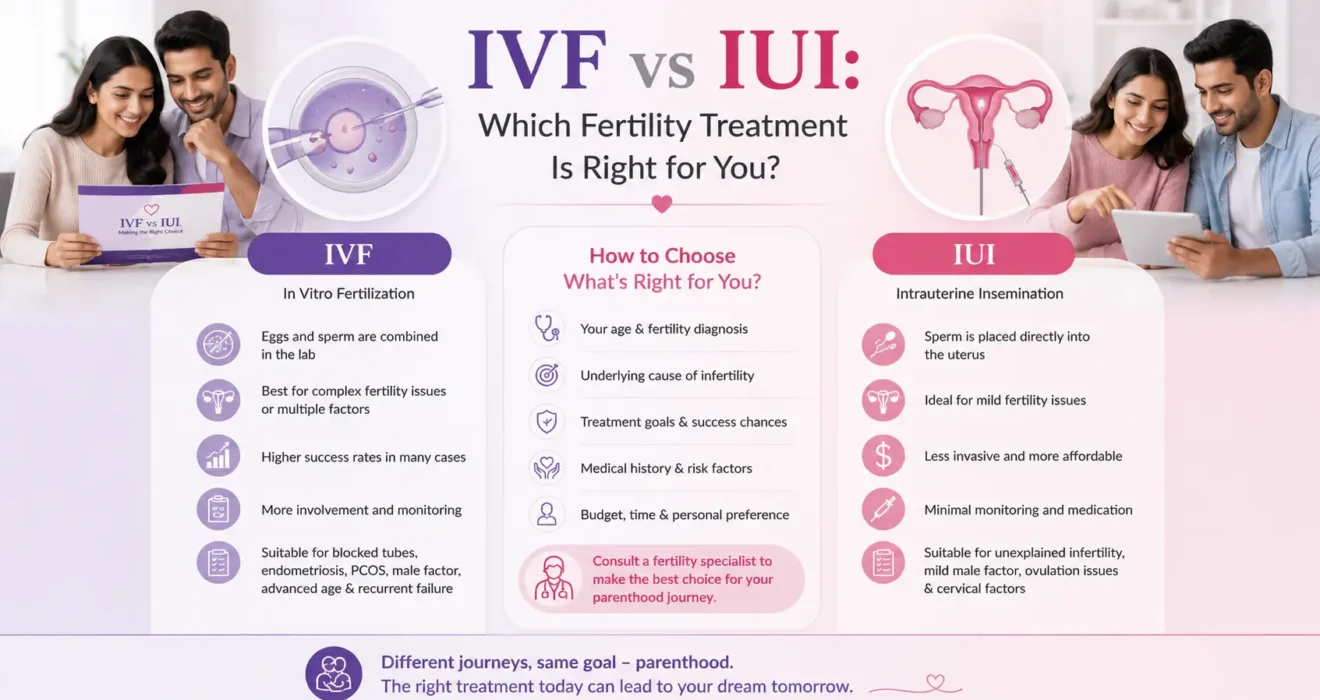
IVF vs IUI: Which Fertility Treatment Is Right for You?
When couples face difficulty conceiving, one of the first questions they often ask is, “Should we choose IUI or IVF?” Both treatments are widely used in fertility care and have helped countless couples achieve pregnancy. However, they differ significantly in terms of procedure, success rates, cost, and who they are best suited for.
Understanding the differences between IUI and IVF can help you make an informed decision and choose the treatment that best fits your fertility needs.
What Is IUI?
IUI (Intrauterine Insemination) is a relatively simple fertility treatment in which specially prepared sperm is placed directly into the uterus around the time of ovulation.
The goal of IUI is to increase the number of healthy sperm reaching the egg, thereby improving the chances of fertilization.
IUI is often considered the first step in fertility treatment because it is less invasive and more affordable than IVF.
What Is IVF?
IVF (In Vitro Fertilization) is an advanced fertility treatment where eggs are retrieved from the ovaries and fertilized with sperm in a laboratory. The resulting embryo is then transferred into the uterus to achieve pregnancy.
IVF allows fertility specialists to closely monitor fertilization and embryo development, making it one of the most effective treatments for infertility.
IUI vs IVF: Understanding the Key Differences
Procedure
IUI Treatment
Mild fertility medications may be used.
Ovulation is monitored.
Processed sperm is placed directly into the uterus.
Fertilization occurs naturally inside the body.
IVF Treatment
Ovarian stimulation produces multiple eggs.
Eggs are retrieved through a minor procedure.
Fertilization occurs in the laboratory.
Selected embryos are transferred into the uterus.
Who Is a Good Candidate for IUI?
IUI may be recommended for:
Mild male infertility
Unexplained infertility
Ovulation disorders
Cervical factor infertility
Couples trying to conceive with donor sperm
IUI is typically most successful when the woman has healthy fallopian tubes and good ovarian function.
Who Is a Good Candidate for IVF?
IVF may be recommended for:
Blocked fallopian tubes
Severe male infertility
Endometriosis
Advanced maternal age
Low ovarian reserve
Recurrent pregnancy loss
Multiple failed IUI cycles
Repeated IVF failures requiring advanced treatment
Genetic testing requirements
For many couples facing complex fertility issues, IVF offers the highest chance of success.
Success Rates: IUI vs IVF
One of the biggest differences between IUI and IVF is the success rate.
IUI success depends on factors such as age, fertility diagnosis, sperm quality, and ovulation timing. While many couples achieve pregnancy through IUI, success rates are generally lower than IVF.
IVF typically offers higher success rates because fertilization and embryo development are carefully managed in a controlled laboratory environment. Advanced techniques such as ICSI, blastocyst culture, and genetic testing can further improve outcomes for selected patients.
How Many Cycles Should You Try?
Many fertility specialists recommend trying IUI for a limited number of cycles if the couple is a suitable candidate.
If pregnancy does not occur after several well-planned IUI cycles, IVF may offer a better chance of success.
The decision depends on:
Age of the female partner
Duration of infertility
Fertility diagnosis
Previous treatment history
Ovarian reserve
Sperm quality
Cost Considerations
IUI is generally less expensive than IVF because it involves fewer medications and procedures.
However, repeated unsuccessful IUI cycles may ultimately delay pregnancy and increase overall treatment costs. In some situations, moving directly to IVF can be a more effective and time-efficient option.
A fertility specialist can help determine the most appropriate treatment based on both medical and financial considerations.
Emotional Aspects of Fertility Treatment
Both IUI and IVF involve emotional highs and lows.
While IUI is simpler and less invasive, IVF often provides greater reassurance because doctors can closely monitor each stage of the process. Having realistic expectations and a strong support system can make the fertility journey easier to navigate.
Remember that every couple’s journey is unique, and there is no one-size-fits-all solution.
How Does Your Fertility Specialist Decide?
Before recommending IUI or IVF, a fertility specialist will evaluate:
Age
Hormone levels
Ovarian reserve
Fallopian tube health
Sperm parameters
Medical history
Previous fertility treatments
Based on these findings, a personalized treatment plan is created to maximize the chances of a healthy pregnancy.
When Should You Move from IUI to IVF?
You may be advised to consider IVF if:
Multiple IUI cycles have failed.
The female partner is over 35 years of age.
There is severe male infertility.
Fallopian tubes are blocked.
Ovarian reserve is low.
Endometriosis is affecting fertility.
Faster results are desired due to age-related fertility decline.
Early intervention can often improve treatment outcomes and reduce emotional stress.
Final Thoughts
Both IUI and IVF are valuable fertility treatments, but the right choice depends on your individual circumstances. While IUI can be an effective first-line treatment for certain fertility issues, IVF offers higher success rates and more advanced solutions for complex infertility cases.
The best way to determine which treatment is right for you is to consult an experienced fertility specialist who can evaluate your unique situation and recommend a personalized path toward parenthood. With the right guidance and treatment approach, your dream of building a family may be closer than you think.