
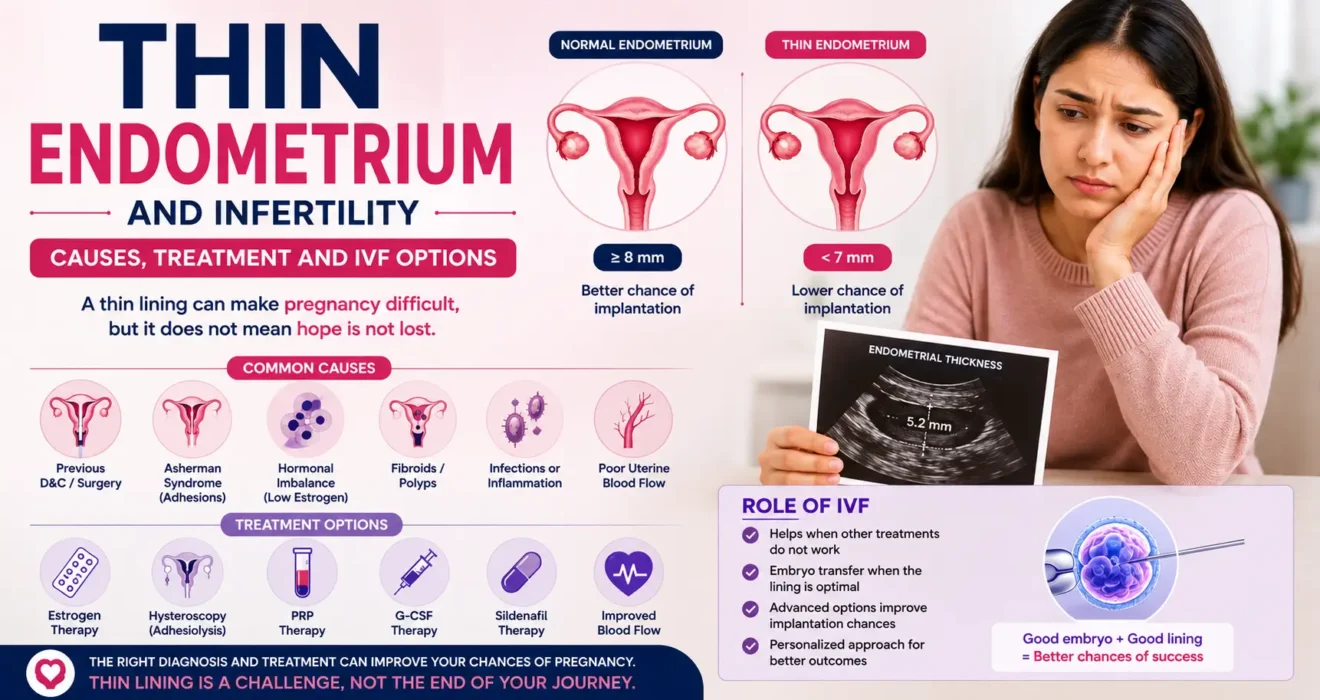
Thin Endometrium and Infertility: Causes, Treatment and When IVF May Help
If you have been told that your endometrial lining is thin, you may already be wondering whether this is the reason you are not getting pregnant.
This is a common concern among women undergoing fertility treatment, especially when an ultrasound shows an endometrial thickness below the level your fertility specialist would ideally like to see before embryo transfer.
The endometrium is the inner lining of the uterus. Every month, it changes in response to hormones and prepares for a possible pregnancy. After ovulation, a fertilized egg needs to implant into the endometrium and establish a pregnancy.
When the lining remains thin, implantation may be less likely. However, thin endometrium does not mean pregnancy is impossible, and there is no single thickness that can perfectly predict whether an IVF cycle will succeed or fail.
Research has found an association between thinner endometrium and lower pregnancy or live birth rates in IVF, particularly below around 7 to 8 mm. At the same time, pregnancies and live births can still occur with a thin lining. More recent evidence also suggests that endometrial thickness is better viewed as one factor in the overall fertility picture rather than as a strict “yes or no” cutoff for embryo transfer.
So if your endometrium is thin, the important questions are:
- Why is the lining thin?
- How thin is it?
- Has it always been thin?
- Has there been previous uterine surgery or infection?
- Is blood flow to the uterus normal?
- Is there an underlying uterine problem?
- Is the lining responding to estrogen?
- Have you had previous failed embryo transfers?
- Should the embryo transfer be delayed?
- Can the lining be improved before IVF or frozen embryo transfer?
This article explains thin endometrium, its causes, symptoms, fertility impact, treatment options and the role of IVF, in simple terms.
What Is the Endometrium?
The endometrium is the inner lining of the uterus, also called the womb.
It changes throughout the menstrual cycle.
During the first part of the cycle, estrogen stimulates the endometrium to grow. After ovulation, progesterone changes the lining and prepares it for possible embryo implantation.
If pregnancy occurs, the embryo implants into the endometrium.
If pregnancy does not occur, hormone levels fall and the endometrial lining is shed as your menstrual period.
This process happens every month during the reproductive years.
For fertility, the endometrium needs to develop appropriately and be receptive at the time an embryo is ready to implant.
That is why your fertility specialist measures endometrial thickness by transvaginal ultrasound during fertility treatment.
What Is a Thin Endometrium?
A thin endometrium means that the uterine lining measures less than the thickness generally expected at a particular stage of the menstrual cycle or fertility treatment.
There is no universally accepted single definition of a thin endometrium.
In IVF practice, an endometrial thickness of less than 7 mm is commonly considered thin, although studies have used different cutoffs, including 6, 7 or 8 mm.
This is important because a number on an ultrasound report should not be interpreted without knowing:
- Which day of the cycle it was measured.
- Whether you are undergoing natural, stimulated or hormone-replacement treatment.
- Whether it is a fresh or frozen embryo transfer cycle.
- Your previous endometrial measurements.
- Whether there are uterine abnormalities.
- Whether the lining has a suitable appearance.
Research involving more than 40,000 embryo transfers found that clinical pregnancy and live birth rates decreased as endometrial thickness fell below 8 mm in fresh IVF cycles and below 7 mm in frozen-thaw cycles. However, viable pregnancies still occurred in women with measurements between approximately 4 and 6 mm.
This is why thin endometrium is a risk factor, not a statement that pregnancy cannot happen.
What Endometrial Thickness Is Best for IVF?
Many fertility clinics prefer an endometrial thickness of around 7 mm or more before embryo transfer, while some clinicians prefer 8 mm or more depending on the individual situation.
But there is no magic number that guarantees pregnancy.
A 2025 systematic review and meta-analysis found that thicker endometrium was generally associated with better reproductive outcomes, but the evidence did not support one absolute threshold below which embryo transfer should always be avoided. The authors concluded that endometrial thickness should be considered alongside other factors rather than used as a strict cutoff.
A recent individual-patient-data analysis published in 2025 also found that live birth rates were highest with endometrial thickness above 10 mm, while women with less than 7 mm still had an acceptable predicted live birth rate. The number of women with very thin endometrium was small, so the results need to be interpreted carefully.
Therefore, if your endometrium is 6.5 mm, it does not mean that IVF cannot work.
It means your fertility specialist may want to look more closely at the complete situation.
Why Is Endometrial Thickness Important in IVF?
During IVF, an embryo is transferred directly into the uterus.
For pregnancy to occur, the embryo must attach to the endometrium and begin implantation.
The endometrium is therefore an important part of the implantation process.
A thin lining may be associated with:
- Lower implantation rates.
- Lower clinical pregnancy rates.
- Lower live birth rates in some studies.
- Higher risk of cycle cancellation in some treatment settings.
However, implantation does not depend on thickness alone.
Embryo quality, embryo genetics, woman’s age, uterine health, hormonal preparation, timing of progesterone exposure and other factors also influence IVF outcomes.
This is why a fertility specialist should not look at the lining in isolation.
Can You Get Pregnant With a Thin Endometrium?
Yes.
This is perhaps the most important message for women who have been told they have a thin lining.
Pregnancy is still possible.
Large IVF datasets have shown that live births can occur even when endometrial thickness is below 7 mm. The chances may be lower compared with thicker endometrium, but they are not zero.
For example, one large analysis reported live birth rates of approximately 15 to 21% in certain groups with endometrial thickness around 5 to 6 mm, depending on whether the cycle was fresh or frozen.
These figures should not be used to predict your individual IVF success rate.
Your age, embryo quality, ovarian reserve, sperm factors, uterine health and treatment history all matter.
The right question is not:
“Is my lining thick enough to get pregnant?”
A better question is:
“Given my lining, embryo and complete fertility history, what treatment approach gives me the best reasonable chance?”
What Causes Thin Endometrium?
Thin endometrium can have several causes.
Sometimes there is an identifiable problem.
Sometimes the lining simply does not respond strongly enough to hormonal stimulation.
Some common causes include:
1. Previous Uterine Surgery or Procedures
Previous procedures inside the uterus can sometimes damage the endometrium.
Examples include:
Dilation and curettage.
Repeated uterine evacuation.
Removal of retained pregnancy tissue.
Hysteroscopic procedures.
Some uterine surgeries.
Repeated uterine instrumentation can sometimes lead to intrauterine adhesions, also known as Asherman syndrome.
These adhesions can reduce the available endometrial surface and may interfere with fertility.
ASRM notes that intrauterine adhesions can develop following uterine instrumentation, including curettage, pelvic infection and some uterine surgeries.
2. Asherman Syndrome and Intrauterine Adhesions
Asherman syndrome occurs when scar tissue forms inside the uterine cavity.
Women may experience:
Very light periods.
Short periods.
Missed periods.
Difficulty conceiving.
Recurrent pregnancy loss.
Thin endometrium.
Abnormal uterine cavity findings.
A history of very light periods after a D&C or miscarriage treatment deserves attention.
If adhesions are suspected, hysteroscopy can be used to directly examine the uterine cavity.
Treatment may involve hysteroscopic removal of adhesions when appropriate.
3. Previous Infection
Certain pelvic or uterine infections can affect the endometrium.
Chronic inflammation may interfere with normal endometrial development.
Your fertility specialist may consider infection or chronic endometrial problems depending on your symptoms, history and previous treatment.
4. Low Estrogen Effect
Estrogen is important for the growth of the endometrium during the first half of the menstrual cycle.
If estrogen stimulation is inadequate, the lining may remain thin.
This can occur in some women with hormonal or ovarian problems.
The reason for inadequate estrogen exposure needs to be identified rather than simply giving increasing doses without understanding the cause.
5. Repeated Clomiphene Use
Clomiphene citrate can be an effective ovulation-induction medicine, but in some women it may have an unfavorable effect on the endometrium or cervical mucus.
If the lining repeatedly remains thin during clomiphene treatment, your fertility specialist may consider a different treatment approach.
The appropriate option depends on the reason for ovulation induction and the woman’s fertility profile.
6. Fibroids or Other Uterine Problems
Not every fibroid causes a thin lining.
However, fibroids, polyps, congenital uterine abnormalities and other cavity problems can affect fertility and implantation.
If the ultrasound suggests a structural problem, further evaluation may be required.
7. Reduced Uterine Blood Flow
Adequate blood supply is important for endometrial development.
Some studies have investigated uterine artery blood flow in women with thin endometrium.
However, Doppler findings should be interpreted carefully and should not be treated as an independent diagnosis.
8. Endometrial Damage
Previous procedures, inflammation, infection or other injury may cause damage to the basal layer of the endometrium.
When the underlying tissue is damaged, simply increasing estrogen may not always produce the desired response.
This is one reason why finding the cause of a thin lining is so important.
Does Thin Endometrium Cause Infertility?
Thin endometrium can be associated with reduced fertility, particularly during IVF and embryo transfer.
However, it is not always the only reason a woman is not conceiving.
Infertility can result from:
Ovulation problems.
Reduced ovarian reserve.
Increasing age.
Endometriosis.
Blocked fallopian tubes.
Male factor infertility.
Uterine abnormalities.
Embryo-related factors.
Multiple factors together.
Thin endometrium may be one part of the picture.
If you have been diagnosed with a thin lining, your fertility specialist should still evaluate the other major causes of infertility.
Thin Endometrium and IVF Success
This is one of the most searched questions by women undergoing IVF.
The relationship between endometrial thickness and IVF success is real, but it is not absolute.
A large study of more than 44,000 fresh and frozen embryo transfers found a decline in clinical pregnancy and live birth rates as endometrial thickness decreased, particularly below 8 mm in fresh cycles and below 7 mm in frozen cycles.
At the same time, researchers have repeatedly found that endometrial thickness has limited ability to predict the outcome of an individual IVF cycle.
The 2014 systematic review found that a thickness of 7 mm or less was associated with a lower clinical pregnancy rate, but also concluded that endometrial thickness alone was not sufficient to justify automatically cancelling treatment or refusing further IVF.
More recent evidence continues to support this balanced approach. A 2025 systematic review found an association between thicker endometrium and better reproductive outcomes, but concluded that endometrial thickness should be considered as a graded prognostic factor rather than a strict threshold for avoiding embryo transfer.
So, thin lining can reduce the probability of success, but it does not make IVF impossible.
What Does a Triple-Line Endometrium Mean?
During ultrasound, your doctor may mention a triple-line, trilaminar or three-line endometrium.
This refers to the appearance of the endometrium on ultrasound.
A typical trilaminar pattern may be seen during the late follicular phase and is often considered a favorable sign during fertility treatment.
However, the endometrial pattern should not be interpreted independently of thickness, hormonal timing and other clinical factors.
Your fertility specialist will assess the overall ultrasound picture.
Can Endometrial Thickness Change During the Cycle?
Yes.
The endometrium naturally changes throughout the menstrual cycle.
It usually becomes thicker during the estrogen-dominant phase and then changes in appearance after ovulation under the influence of progesterone.
This means that an endometrial measurement is meaningful only when we know when it was measured.
For example, a lining measurement taken immediately after menstruation cannot be interpreted in the same way as a measurement taken just before ovulation or embryo transfer.
This is why fertility clinics monitor the lining at specific points during treatment.
How Is Thin Endometrium Diagnosed?
The most common method is transvaginal ultrasound.
During an ultrasound, the fertility specialist may assess:
Endometrial thickness.
Endometrial pattern.
Uterine cavity.
Ovaries.
Fibroids.
Polyps.
Other structural findings.
If the lining repeatedly remains thin despite appropriate hormonal preparation, additional evaluation may be considered.
Depending on your history, your doctor may recommend:
Saline infusion sonography.
Hysteroscopy.
HSG.
Pelvic ultrasound.
Hormonal evaluation.
Evaluation for intrauterine adhesions.
Other tests based on symptoms and previous treatment.
A thin lining that occurs once is different from a repeatedly thin endometrium across several treatment cycles.
What Is the Treatment for Thin Endometrium?
Treatment depends on the cause.
There is no single medicine that works for every woman.
The first step is to identify why the endometrium is thin.
Depending on the situation, treatment may include:
Adjusting estrogen treatment.
Changing the fertility protocol.
Treating intrauterine adhesions.
Treating uterine abnormalities.
Addressing hormonal problems.
Considering selected medications or adjunctive treatments.
Delaying embryo transfer until the endometrium is considered more suitable.
Considering alternative embryo-transfer strategies.
Your fertility specialist will decide which approach is appropriate based on your medical history and previous treatment response.
Can Estrogen Improve Thin Endometrium?
Estrogen plays an important role in endometrial growth.
In hormone-replacement frozen embryo transfer cycles, estrogen is commonly used to develop the endometrium before progesterone is started.
If the lining is not responding adequately, the fertility specialist may adjust:
Estrogen dose.
Route of administration.
Duration of estrogen treatment.
Timing of progesterone.
Overall preparation protocol.
However, more estrogen does not automatically mean a better lining.
If the endometrium remains thin despite adequate estrogen exposure, the doctor should consider whether there is an underlying uterine problem.
Can Sildenafil Help Thin Endometrium?
Sildenafil has been studied as a possible treatment for thin endometrium because of its potential effect on blood flow.
A 2020 systematic review and meta-analysis of nine studies involving 1,452 women found that sildenafil was associated with increased endometrial thickness and higher clinical pregnancy rates compared with control groups.
However, this does not mean sildenafil is appropriate for every woman with a thin lining.
The treatment is not a universal solution, and the evidence base includes studies with different protocols and populations.
If your fertility specialist believes it may be appropriate, it should be used under medical supervision.
Do not take sildenafil or any other prescription medicine on your own based on something you read online.
What About G-CSF for Thin Endometrium?
Granulocyte colony-stimulating factor (G-CSF) has been investigated as another possible treatment for thin endometrium.
Some studies have reported improvements in endometrial thickness and pregnancy outcomes.
A 2023 systematic review and meta-analysis of randomized trials found that G-CSF increased endometrial thickness and clinical pregnancy rates in women undergoing IVF who had thin endometrium. However, the results were not the same in the general IVF population.
ASRM has previously reviewed G-CSF studies and noted inconsistent findings, with possible benefit in selected women with thin endometrium or repeated implantation failure but substantial variation between studies.
Therefore, G-CSF should be considered a selective treatment rather than a routine treatment for every IVF patient.
Can PRP Improve Thin Endometrium?
Platelet-rich plasma (PRP) has attracted significant interest in fertility treatment for women with refractory thin endometrium.
PRP is prepared from the patient’s own blood and has been investigated for its possible effect on endometrial regeneration and blood supply.
Several studies have reported an increase in endometrial thickness after PRP.
A 2024 meta-analysis of eight randomized controlled trials involving 678 women reported improvements in endometrial thickness, clinical pregnancy and live birth rates with intrauterine PRP compared with controls. However, the authors also noted limitations such as sample size and study heterogeneity and called for larger, higher-quality trials.
A 2025 network meta-analysis also found that PRP, G-CSF and sildenafil were associated with improvements in endometrial thickness, while the evidence for live birth was less convincing across the different treatments.
A 2026 systematic review of PRP in frozen embryo transfer cycles reported an increase in endometrial thickness but emphasized that well-designed, large randomized trials are still needed.
So if you are considering PRP, ask your fertility specialist:
“What evidence supports PRP for someone with my specific history, and what are the alternatives?”
It should not be presented as a guaranteed treatment.
Can Aspirin Help Thin Endometrium?
Low-dose aspirin has been studied in fertility treatment because of its potential effects on blood flow.
However, aspirin is not a routine treatment for every woman with thin endometrium.
A 2025 network meta-analysis found that some adjuvant therapies, including aspirin, were associated with improved clinical pregnancy outcomes in certain study populations, but the included treatments did not show a clear improvement in live birth across the analyses.
Aspirin can also have risks and should not be started simply because your endometrium is thin.
Only take it when your fertility specialist recommends it for a specific reason.
Can Vitamin E Improve Thin Endometrium?
Vitamin E has been investigated as part of treatment strategies for thin endometrium, particularly because of its possible antioxidant and vascular effects.
Small studies have reported improvements in endometrial thickness and blood-flow measurements.
However, these studies are not enough to say that vitamin E is a proven treatment for thin endometrium or that it improves live birth in every IVF patient.
Your doctor can advise whether supplementation is appropriate for you.
Avoid taking high-dose supplements without medical advice.
Does PRP, G-CSF or Sildenafil Guarantee IVF Success?
No.
This is extremely important.
A treatment that increases endometrial thickness does not necessarily guarantee that implantation or live birth will occur.
Endometrial thickness is only one part of the implantation process.
The embryo also matters.
For example, a woman may have:
A 9 mm endometrium but a poor-quality embryo.
A 6.5 mm endometrium with a good-quality embryo.
A normal lining but an untreated uterine cavity problem.
A good lining and embryo but another fertility factor.
Therefore, the goal should not simply be:
“Make the lining thicker.”
The goal should be:
“Identify and correct the factors that may be affecting implantation and pregnancy.”
Should Embryo Transfer Be Cancelled if the Endometrium Is Thin?
Not automatically.
The decision depends on how thin the lining is, whether it has improved during monitoring, the type of cycle, embryo quality, previous history and the fertility clinic’s protocol.
Older evidence suggested avoiding embryo transfer below certain measurements, but newer evidence shows that pregnancies and live births can still occur with thin endometrium and that there is no universally valid cutoff below which transfer must always be cancelled.
If your lining is thin, your fertility specialist may discuss:
Continuing estrogen for longer.
Changing the preparation protocol.
Investigating the uterus.
Delaying transfer.
Freezing embryos and transferring later.
Proceeding with transfer after discussing the risks and chances.
The decision should be individualized.
Thin Endometrium in Fresh IVF vs Frozen Embryo Transfer
The relationship between endometrial thickness and IVF outcomes can differ between fresh and frozen cycles.
In a fresh IVF cycle, the lining develops during ovarian stimulation.
In a frozen embryo transfer cycle, the endometrium may be prepared using:
A natural cycle.
A modified natural cycle.
Hormone replacement.
The best approach depends on whether you ovulate regularly and on your individual medical situation.
Some women with a thin lining during one type of preparation may respond differently under another protocol.
This is one reason why repeated assessment and individualized treatment can be useful.
Can a Thin Endometrium Be Caused by Asherman Syndrome?
Yes.
This is particularly important if you have:
Very light periods.
A history of D&C.
Previous miscarriage treatment.
Previous retained placenta or retained pregnancy tissue.
Previous uterine surgery.
Repeated failed implantation.
A suddenly thinner lining after a uterine procedure.
Intrauterine adhesions can reduce the available endometrial surface.
Hysteroscopy allows direct visualization of the uterine cavity and can be used to diagnose and, when appropriate, treat adhesions.
ASRM’s 2026 recurrent pregnancy loss guidance recognizes intrauterine adhesions as a possible consequence of uterine instrumentation and notes that hysteroscopic treatment of mild and moderate adhesions may be considered in selected circumstances.
Can Hysteroscopy Help With Thin Endometrium?
Hysteroscopy can be useful when there is concern about a problem inside the uterine cavity.
It may identify:
Intrauterine adhesions.
Endometrial polyps.
Submucosal fibroids.
Scar tissue.
Other cavity abnormalities.
If the thin endometrium is caused by adhesions, treating the adhesions may be more important than simply trying different medicines to increase the thickness.
This is why the cause of thin endometrium matters.
Does Thin Endometrium Mean Poor Uterine Health?
Not necessarily.
A thin measurement does not tell us everything about the uterus.
The endometrium is a dynamic tissue, and its appearance changes throughout the menstrual cycle.
The quality of the uterine cavity, blood supply, hormonal environment and endometrial receptivity all matter.
Thickness is an accessible measurement, which is why it is commonly used during fertility treatment.
But it is not a complete test of endometrial receptivity.
Can Diet Increase Endometrial Thickness?
There is no specific food that has been proven to reliably increase endometrial thickness enough to improve IVF success.
Eating a balanced diet is important for general health and fertility.
Focus on:
Adequate protein.
Fruits and vegetables.
Whole grains.
Healthy fats.
Adequate hydration.
Appropriate calorie intake.
Maintaining a healthy body weight.
But do not rely on foods, juices or home remedies to treat a persistently thin endometrium.
If the underlying cause is intrauterine adhesions or another medical condition, diet alone cannot correct it.
Can Exercise Improve Thin Endometrium?
Regular physical activity is beneficial for general health.
However, there is no reliable exercise program proven to directly increase endometrial thickness enough to improve IVF outcomes.
Very intense exercise combined with inadequate nutrition can sometimes interfere with reproductive hormones.
If you have irregular periods, low body weight or hormonal problems, discuss your exercise routine with your doctor.
Can Stress Cause Thin Endometrium?
Stress can affect reproductive health in different ways, particularly when it affects sleep, eating, weight or hormonal function.
But if your ultrasound shows a persistently thin endometrium, do not assume that stress is the cause.
A thin lining should be evaluated medically.
You should not be made to feel that your fertility problem is simply because you are “too stressed.”
Infertility is a medical condition and deserves proper assessment.
What If My Endometrium Is Thin in Every IVF Cycle?
This is often called refractory thin endometrium when the lining remains thin despite standard treatment.
If this is happening repeatedly, your doctor may review:
Previous uterine procedures.
Menstrual history.
Ultrasound findings.
Estrogen response.
Uterine blood flow when clinically relevant.
Previous IVF protocols.
Embryo transfer history.
Possible intrauterine adhesions.
Other uterine abnormalities.
Further evaluation may include hysteroscopy or other uterine cavity assessment.
Only after the underlying causes have been considered should additional treatments be discussed.
What Should You Ask Your IVF Doctor About Thin Endometrium?
If your lining is thin, do not hesitate to ask specific questions.
You can ask:
What is my exact endometrial thickness?
On which day of my cycle was it measured?
Is the endometrial pattern favorable?
Has my lining been thin in previous cycles?
Why do you think my lining is thin?
Could I have intrauterine adhesions?
Do I need hysteroscopy?
Should we change the estrogen protocol?
Would a natural or hormone-replacement FET be better for me?
Should we delay embryo transfer?
Would PRP or another treatment be appropriate in my case?
What are the benefits and limitations of the proposed treatment?
What happens if my lining remains below 7 mm?
What are my chances with my embryo and my overall fertility history?
These questions can help you make a decision based on your actual situation rather than on a single number.
When Should You See an IVF Specialist for Thin Endometrium?
You should consider a fertility consultation if:
Your endometrium is repeatedly below 7 mm during fertility treatment.
You have had repeated failed embryo transfers.
Your periods became unusually light after a D&C.
You have a history of uterine surgery.
You have had recurrent miscarriage.
You have been diagnosed with intrauterine adhesions.
Your lining does not respond to estrogen.
You have unexplained infertility.
You are preparing for IVF or frozen embryo transfer.
A specialist can help determine whether the thin lining is a temporary treatment issue or a sign of an underlying uterine problem.
Thin Endometrium and IVF. What Is the Best Approach?
There is no single “best medicine” for every woman with thin endometrium.
A good treatment plan starts with the cause.
For example:
If estrogen response is inadequate:
Your doctor may adjust the hormonal preparation.
If there are intrauterine adhesions:
Hysteroscopic treatment may be considered.
If the lining remains thin despite standard treatment:
Selected adjunctive therapies may be discussed.
If previous embryo transfers have failed:
Your doctor may review both the uterus and embryo-related factors.
If a frozen embryo transfer is planned:
The preparation protocol may be adjusted according to your ovulation and previous response.
The treatment should be individualized rather than based on a single universal protocol.
Is Thin Endometrium a Reason to Give Up on IVF?
No.
This is something I want women to understand clearly.
A thin lining can make fertility treatment more challenging.
It may reduce the probability of implantation or live birth, particularly at very low measurements.
But it does not mean that IVF cannot work.
Research has documented pregnancies and live births even with endometrial thickness below commonly preferred thresholds.
The important thing is to understand your individual situation.
If you have a good-quality embryo and a thin endometrium, your fertility specialist can discuss whether additional preparation may be useful or whether embryo transfer should proceed after counselling.
There is no reason to assume that one ultrasound measurement decides your entire fertility journey.
Conclusion
Being told that you have a thin endometrium can be worrying, especially when you are preparing for IVF or have already experienced an unsuccessful embryo transfer.
But a thin lining is not the same as infertility, and it does not mean that pregnancy is impossible.
Endometrial thickness is associated with IVF outcomes, particularly when the lining becomes very thin. However, current evidence does not support treating one measurement as an absolute cutoff that determines whether pregnancy can happen.
The most important step is to find out why your endometrium is thin.
If there is a uterine problem such as intrauterine adhesions, treating that problem may be more important than simply increasing the thickness.
If the uterus appears normal, your fertility specialist may consider changes to the hormonal preparation or selected treatments such as sildenafil, G-CSF or PRP. These treatments have shown promising results in some studies, but none should be presented as a guaranteed way to improve IVF success.
Your age, embryo quality, ovarian reserve, sperm factors, uterine health and previous IVF history all matter.
Do not let one number on an ultrasound report decide your fertility journey.
If you have a persistently thin endometrium, especially before IVF or frozen embryo transfer, speak with your fertility specialist about the possible cause, treatment options and whether changing your embryo-transfer plan could be helpful.
About Dr. Shipra Singla
Dr. Shipra Singla is an infertility and IVF specialist helping couples understand fertility problems and choose treatment according to their individual needs.
If you have been diagnosed with thin endometrium, repeated implantation failure or unsuccessful IVF, a detailed fertility consultation can help identify possible causes and discuss appropriate treatment options before your next embryo transfer.
A thin lining can make treatment more challenging, but it does not mean that hope is lost.
Frequently Asked Questions About Thin Endometrium
What is considered a thin endometrium?
An endometrial thickness below approximately 7 mm is commonly described as thin in IVF practice, although definitions vary between studies and clinics.
Can I get pregnant with a thin endometrium?
Yes. Pregnancy and live birth are possible even with a thin endometrium, although success rates may be lower at very low thicknesses.
What is the ideal endometrial thickness for IVF?
Many clinics prefer at least 7 mm, and some prefer 8 mm or more. However, there is no single thickness that guarantees IVF success.
Is 6 mm endometrium enough for IVF?
Pregnancy can occur with a 6 mm lining. Whether embryo transfer should proceed depends on the individual case, embryo quality, treatment type and previous history.
Is 5 mm endometrium too thin for embryo transfer?
A 5 mm lining is considered very thin, and implantation chances may be lower. However, pregnancy and live birth can still occur in some women.
Can estrogen increase endometrial thickness?
Estrogen stimulates endometrial growth and is commonly used during hormone-replacement embryo transfer cycles. If the lining remains thin despite appropriate estrogen exposure, the underlying cause should be investigated.
Can PRP improve thin endometrium?
Some randomized trials and meta-analyses suggest that PRP may increase endometrial thickness and may improve pregnancy outcomes in selected women. However, the evidence is still developing, and larger high-quality trials are needed.
Can G-CSF help thin endometrium?
Some studies suggest that G-CSF may improve endometrial thickness and pregnancy outcomes in selected women with thin endometrium. However, evidence has been inconsistent, and it is not a routine treatment for every IVF patient.
Can sildenafil help thin endometrium?
Studies have reported improvements in endometrial thickness and clinical pregnancy rates with sildenafil in women with thin endometrium. However, it should only be used when prescribed and monitored by a fertility specialist.
Can a D&C cause thin endometrium?
Repeated uterine instrumentation, including curettage, can sometimes lead to intrauterine adhesions that may affect the endometrium and fertility.
Can Asherman syndrome cause thin endometrium?
Yes. Intrauterine adhesions can reduce the available endometrial surface and may cause light periods, infertility or recurrent pregnancy problems.
Does thin endometrium cause miscarriage?
Thin endometrium has been associated with some adverse IVF outcomes, but miscarriage is influenced by many factors. A thin lining should not automatically be considered the sole cause of miscarriage.
Can a thin endometrium be cured?
Sometimes the underlying cause can be treated, particularly when adhesions or another uterine problem is identified. In other cases, the lining may remain thin despite treatment.
Should I cancel IVF if my endometrium is thin?
Not necessarily. The decision depends on the thickness, embryo, treatment type, previous history and your fertility specialist’s assessment. Evidence does not support using one universal thickness cutoff to automatically cancel all embryo transfers.
Does thin endometrium mean poor egg quality?
No. Endometrial thickness and egg quality are different fertility factors.
Can food increase endometrial thickness?
No specific food has been proven to reliably increase endometrial thickness enough to improve IVF success. A balanced diet supports general health but does not replace medical treatment.
Can exercise make the endometrium thicker?
There is no strong evidence that a particular exercise routine directly treats thin endometrium.
What should I do if my endometrium is always thin?
Ask your fertility specialist to investigate the cause, especially if the problem persists across several cycles or you have a history of uterine procedures or failed embryo transfers.