
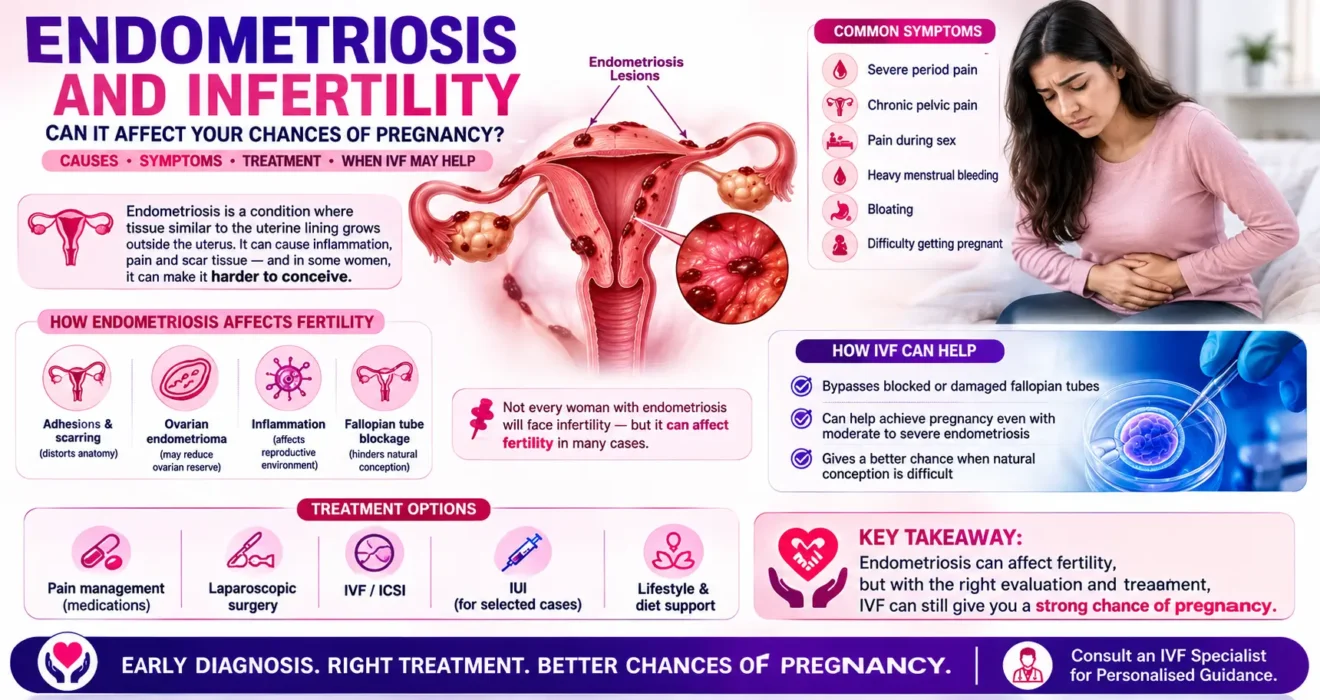
Endometriosis and Infertility: Causes, Symptoms, Treatment and When IVF May Help
If you have endometriosis and are trying to get pregnant, you may have many questions.
Why am I not getting pregnant?
Can endometriosis cause infertility?
Do I need surgery before IVF?
Will endometriosis affect my egg quality?
Can I get pregnant naturally with endometriosis?
Is IVF the best option?
These are very common concerns.
Endometriosis can affect fertility, but it does not mean that pregnancy is impossible. Many women with endometriosis conceive naturally, while others may need fertility treatment such as ovulation induction, IUI or IVF.
The right treatment depends on several factors, including your age, ovarian reserve, duration of infertility, symptoms, severity and location of endometriosis, presence of an endometrioma, fallopian tube function and your partner’s fertility.
Endometriosis is a chronic condition in which tissue similar to the lining of the uterus grows outside the uterus. It can cause inflammation, pain and scar tissue, and in some women it can affect the reproductive organs. ACOG estimates that endometriosis affects about 1 in 10 women of reproductive age.
For a woman trying to conceive, the most important thing is not simply knowing that endometriosis is present.
The important question is:
How is endometriosis affecting your fertility, and what treatment gives you the best chance of pregnancy without unnecessary delay?
What Is Endometriosis?
Endometriosis is a condition in which tissue similar to the endometrium, the lining inside the uterus, grows outside the uterus.
It can occur around:
- The ovaries
- Fallopian tubes
- Pelvic lining
- Outer surface of the uterus
- Bladder
- Bowel
- Rectum
- Other areas of the pelvis
This tissue responds to hormonal changes during the menstrual cycle.
It can become inflamed and bleed, which may lead to irritation, pain and the formation of scar tissue called adhesions. These adhesions can cause pelvic organs to stick together and may sometimes affect the fallopian tubes and ovaries.
Endometriosis can be mild in one woman and extensive in another.
Some women have severe pain with relatively limited disease.
Others have significant endometriosis but very few symptoms.
This is why symptoms alone do not tell us how much endometriosis is affecting fertility.
Can Endometriosis Cause Infertility?
Yes, endometriosis can contribute to infertility.
But having endometriosis does not automatically mean that you are infertile.
Endometriosis may affect fertility through several mechanisms.
Inflammation can affect the pelvic environment. Adhesions can distort the normal anatomy of the reproductive organs. Endometriomas can affect the ovaries. In more advanced disease, the fallopian tubes may become blocked or their normal function may be disturbed.
ACOG notes that almost 4 in 10 women with infertility may have endometriosis, although the exact relationship between endometriosis and infertility is complex.
Importantly, infertility may have more than one cause.
A woman with endometriosis may also have:
- Reduced ovarian reserve
- Age-related decline in fertility
- Ovulation problems
- Blocked fallopian tubes
- Adenomyosis
- Fibroids
- Male factor infertility
- Low sperm count
- Poor sperm motility
- Unexplained infertility
Therefore, it is important not to assume that endometriosis is automatically the only reason you are not conceiving.
How Does Endometriosis Affect Fertility?
Endometriosis can affect fertility in different ways.
1. Pelvic Adhesions
Repeated inflammation and bleeding can cause scar tissue.
These adhesions may make the ovaries, fallopian tubes and uterus stick to surrounding tissues.
In severe disease, this can change the normal anatomy of the pelvis.
This can make it more difficult for the egg and sperm to meet naturally.
2. Fallopian Tube Problems
The fallopian tubes play an important role in natural conception.
After ovulation, the egg needs to be picked up by the fallopian tube.
Sperm then travel through the reproductive tract toward the egg.
Endometriosis-related adhesions can interfere with this process.
In severe cases, the tubes may become blocked or significantly distorted.
3. Ovarian Endometrioma
Endometriosis can affect the ovaries and lead to an ovarian endometrioma, sometimes called a chocolate cyst.
Endometriomas can vary in size.
They may affect the ovarian environment and, in some women, ovarian reserve.
This is particularly important when a woman is planning IVF because the number of eggs available for treatment may already be reduced in some women with ovarian endometriosis.
4. Inflammation
Endometriosis is associated with chronic inflammation.
Inflammatory changes in the pelvis may affect the environment around the egg, sperm and reproductive organs.
5. Changes in Pelvic Anatomy
Advanced endometriosis can cause the ovaries, uterus and fallopian tubes to become displaced or attached to surrounding structures.
This may make natural conception more difficult.
6. Possible Effects on Egg Quantity
Endometriosis involving the ovaries may be associated with reduced ovarian reserve in some women.
This does not mean every woman with endometriosis will have low AMH.
But if endometriosis affects the ovaries, particularly when endometriomas are present or surgery has been performed, ovarian reserve should be considered when planning fertility treatment.
What Are the Symptoms of Endometriosis?
Symptoms vary greatly from woman to woman.
Common symptoms include:
- Severe period pain
- Chronic pelvic pain
- Pain during sex
- Pain during bowel movements
- Pain while urinating, particularly around periods
- Heavy menstrual bleeding
- Lower back or pelvic pain
- Bloating
- Fatigue
- Difficulty getting pregnant
ACOG notes that some women have no symptoms at all and discover endometriosis during infertility evaluation or surgery for another reason. (ACOG)
This is important because absence of pain does not rule out endometriosis.
Similarly, severe period pain does not necessarily mean that a woman has severe-stage endometriosis.
Is Severe Period Pain Normal?
Many women are told that painful periods are simply part of being a woman.
They are not something you should always ignore.
Mild discomfort during menstruation can be common.
But if your period pain:
- Makes you miss work or college
- Requires strong pain medication
- Prevents normal daily activities
- Causes vomiting or severe weakness
- Is getting worse over time
- Is associated with pain during sex
- Is associated with painful bowel movements
- Continues despite routine painkillers
you should discuss it with a gynecologist.
Severe or persistent pelvic pain can be one of the signs that endometriosis needs to be considered.
Can You Have Endometriosis Without Pain?
Yes.
Some women have endometriosis without obvious symptoms.
They may discover it when they are having difficulty conceiving.
This is one reason fertility evaluation is important when pregnancy does not occur as expected.
ASRM notes that peritoneal factors such as endometriosis can contribute to infertility, and laparoscopy is the direct method for diagnosing these pelvic factors, although routine diagnostic laparoscopy is not recommended for every woman with infertility.
How Is Endometriosis Diagnosed?
Diagnosis starts with your symptoms and medical history.
Your doctor may ask about:
- Period pain
- Menstrual bleeding
- Pain during sex
- Bowel symptoms
- Urinary symptoms
- Previous surgeries
- Previous pregnancies
- Infertility duration
- Family history
- Previous ultrasound reports
A pelvic examination may also be performed.
Ultrasound
A transvaginal ultrasound can identify some forms of endometriosis, particularly ovarian endometriomas and certain deep endometriosis findings.
However, a normal ultrasound does not necessarily rule out all endometriosis.
MRI
MRI may be useful in selected women, particularly when deep endometriosis is suspected or the anatomy needs further evaluation.
Laparoscopy
Laparoscopy allows direct visualization of the pelvis.
Historically, surgery was considered the definitive way to diagnose endometriosis. However, newer guidance emphasizes that diagnosis and treatment should be individualized, and surgery is not automatically required simply to confirm the condition. ACOG’s 2026 clinical practice guideline provides updated recommendations for evaluating and diagnosing endometriosis.
What Are the Stages of Endometriosis?
Endometriosis is commonly classified into four stages:
- Stage I: Minimal
- Stage II: Mild
- Stage III: Moderate
- Stage IV: Severe
These stages are based on the extent and location of the disease, including implants, adhesions and ovarian involvement.
However, stage does not always predict how much pain a woman will have.
A woman with Stage I disease may experience severe pain.
Another woman with Stage IV disease may have relatively few symptoms.
Similarly, the stage alone does not tell us exactly how easily you will become pregnant.
Your fertility treatment should be based on your complete clinical picture.
Can Endometriosis Be Cured?
There is currently no guaranteed permanent cure for endometriosis.
Treatment can control symptoms, remove visible disease in selected cases and help women achieve pregnancy.
However, endometriosis can return after treatment.
ACOG notes that pain may recur after surgery, and recurrence is more likely with more severe disease.
This is why treatment planning should consider both:
Your current symptoms
and
Your fertility goals.
A woman who wants to become pregnant soon may need a different treatment strategy from someone who wants to control pain but is not planning pregnancy.
Can Endometriosis Be Treated With Medicines?
Yes.
Hormonal medicines are commonly used to control endometriosis-related pain.
These may include:
- Combined hormonal contraceptives
- Progestin medications
- GnRH agonists
- GnRH antagonists
- Other hormonal treatments
These treatments can be useful for controlling symptoms.
However, they are generally not fertility treatments because many suppress ovulation while you are taking them.
ACOG explains that hormonal treatments can slow endometriosis activity and help control symptoms, but they do not remove existing endometriosis tissue.
If you are actively trying to conceive, your fertility specialist needs to know this before starting hormonal treatment.
Can Endometriosis Treatment Help You Get Pregnant?
It depends on the treatment.
Pain-control medicines can improve your quality of life but do not necessarily improve the chance of natural conception.
Surgery may improve fertility in selected women, particularly when endometriosis causes adhesions or distorts pelvic anatomy.
However, surgery is not automatically the best fertility treatment for every woman.
The ESHRE endometriosis guideline recommends individualized decision-making regarding surgery and fertility treatment, particularly because the reproductive benefit of surgery can vary depending on the type and severity of disease.
Can Endometriosis Be Treated With Surgery?
Yes.
Surgery is usually performed laparoscopically when appropriate.
The surgeon may:
- Remove endometriosis lesions.
- Separate adhesions.
- Treat endometriomas.
- Restore pelvic anatomy where possible.
Surgery may be particularly useful when a woman has:
- Severe pelvic pain
- Deep endometriosis
- Significant adhesions
- Large endometriomas
- Distorted pelvic anatomy
- Other surgical indications
However, surgery involving the ovaries requires particular care in women who want future fertility.
Can Endometriosis Surgery Improve Fertility?
In selected women, yes.
But surgery should not automatically be performed just because endometriosis is present.
For mild endometriosis, the fertility benefit of surgery is relatively limited and evidence is not strong enough to recommend surgery solely to increase pregnancy chances in every woman.
For more advanced disease, surgery may help restore pelvic anatomy and may be considered depending on symptoms, age, ovarian reserve and fertility plans.
This is why the decision should be individualized.
Should I Have Endometriosis Surgery Before IVF?
This is one of the most important questions for women with endometriosis.
Not always.
Surgery before IVF may be considered when there is a specific reason.
For example:
- Severe pain
- Large endometrioma
- Difficulty accessing follicles during egg retrieval
- Suspicion of malignancy
- Severe deep endometriosis requiring treatment
- Significant pelvic anatomy distortion
- Other symptoms requiring surgery
However, surgery simply to improve IVF success is not automatically recommended for every woman.
The ESHRE guideline states that surgery for endometrioma before assisted reproductive treatment can be considered to improve pain or follicle accessibility, but there is no clear evidence that routine surgery improves reproductive outcomes. For deep endometriosis, the reproductive benefit of surgery before ART is also uncertain.
This is especially important because ovarian surgery can sometimes reduce ovarian reserve.
Can Endometrioma Surgery Reduce AMH?
It can.
This is an important consideration before surgery.
An endometrioma is located in or around the ovary, and surgery can sometimes remove or damage healthy ovarian tissue along with the cyst.
This may affect ovarian reserve.
Therefore, if you have an endometrioma and are planning IVF, your doctor may assess:
- AMH
- Antral follicle count
- Age
- Endometrioma size
- Whether it is one ovary or both ovaries
- Previous ovarian surgery
- IVF plans
- Pain symptoms
The goal is to avoid unnecessary ovarian surgery when the expected fertility benefit is unclear.
Can Endometriosis Cause Low AMH?
Endometriosis, particularly ovarian endometriosis, can be associated with lower ovarian reserve in some women.
However, endometriosis does not automatically mean low AMH.
AMH should be interpreted together with antral follicle count, age and other fertility information.
If you have an endometrioma and are planning pregnancy, checking ovarian reserve can be particularly useful for treatment planning.
Can You Get Pregnant Naturally With Endometriosis?
Yes.
Many women with endometriosis conceive without IVF.
Your chance of natural conception depends on:
- Age
- Ovarian reserve
- Ovulation
- Fallopian tube function
- Severity of endometriosis
- Presence of adhesions
- Endometrioma
- Duration of infertility
- Sperm quality
- Previous pregnancy history
If you are young, have mild disease, regular ovulation, open tubes and no significant male factor, your doctor may discuss trying naturally or using IUI.
But if you have been trying for a long time, have advanced endometriosis or are older, waiting may not be the best strategy.
When Should You See a Fertility Specialist?
You should consider an early fertility evaluation if you have known endometriosis and want to become pregnant.
You should especially seek help if:
- You have been trying to conceive without success.
- You are 35 or older.
- You have an endometrioma.
- You have severe period pain.
- You have previous endometriosis surgery.
- You have blocked or damaged fallopian tubes.
- Your ovarian reserve is low.
- Your partner has abnormal semen parameters.
- You have already experienced failed fertility treatment.
ASRM recommends earlier evaluation when there is a known condition associated with infertility rather than waiting for the standard period of trying to conceive.
Endometriosis and Age. Why Does It Matter?
Age is an important factor in fertility for every woman.
As age increases, both egg quantity and egg quality can decline.
When endometriosis is also present, the treatment timeline can become more important.
For example, a 28-year-old woman with mild endometriosis may have time to consider different treatment approaches.
A 38-year-old woman with endometriosis and reduced ovarian reserve may need a more time-efficient plan.
This is why fertility treatment should never be based only on the stage of endometriosis.
Age + ovarian reserve + endometriosis + fertility history all need to be considered.
When Is IUI Used for Endometriosis?
IUI, or intrauterine insemination, may be considered in selected women with mild endometriosis.
During IUI, prepared sperm are placed directly inside the uterus around ovulation.
IUI may be considered when:
- Endometriosis is mild.
- Fallopian tubes are open.
- Ovulation is occurring.
- Ovarian reserve is reasonable.
- Male factor is absent or mild.
- The woman is relatively young.
- There are no major pelvic anatomical problems.
IUI is less likely to be suitable when severe endometriosis has distorted the pelvis or when the fallopian tubes are significantly affected.
When Is IVF Recommended for Endometriosis?
IVF may be recommended when endometriosis is significantly affecting fertility or when other factors make IVF more appropriate.
IVF may be considered when:
- Fallopian tubes are blocked.
- Endometriosis is moderate or severe.
- There are significant pelvic adhesions.
- There is an endometrioma affecting ovarian function or treatment access.
- IUI has failed.
- The woman is older.
- Ovarian reserve is reduced.
- There is male factor infertility.
- The couple has been trying for a long time.
- Previous fertility treatment has not worked.
- A faster route to pregnancy is preferred.
IVF bypasses the need for the egg and sperm to meet naturally inside the fallopian tube.
This can be particularly useful when endometriosis has affected the tubes or pelvic anatomy.
Can IVF Work With Endometriosis?
Yes.
Many women with endometriosis become pregnant through IVF.
Endometriosis may affect IVF outcomes in some women, but IVF remains an important fertility treatment for endometriosis-associated infertility.
ASRM notes that IVF can maximize the chance of pregnancy per treatment cycle for women with endometriosis, particularly when pelvic anatomy is significantly affected.
The ESHRE guideline also recognizes ART as an important option for endometriosis-associated infertility, with treatment decisions based on factors such as age, ovarian reserve, previous surgery, symptoms and other infertility factors.
Does Endometriosis Reduce IVF Success?
It may.
Some studies have reported lower IVF outcomes in women with endometriosis compared with women undergoing IVF for certain other infertility causes.
However, IVF success varies significantly between individuals.
Your outcome depends on:
- Age
- Number of eggs retrieved
- Ovarian reserve
- Egg quality
- Sperm quality
- Embryo development
- Endometrioma
- Uterine health
- Endometriosis severity
- Previous IVF history
Therefore, you should not assume that endometriosis means IVF will fail.
It simply means that your fertility specialist may need to consider additional factors when planning your treatment.
Does Endometriosis Affect Egg Quality?
This is a common concern.
Endometriosis may affect the ovarian environment and has been associated with changes in ovarian reserve and reproductive outcomes.
However, it is difficult to say that endometriosis alone determines egg quality.
Age remains one of the strongest factors affecting egg quality.
A woman with endometriosis at 30 may have a very different fertility outlook from a woman with endometriosis at 39.
This is why age and ovarian reserve should be evaluated before deciding whether to proceed with surgery, IUI or IVF.
What Is an Endometrioma?
An endometrioma is an ovarian cyst caused by endometriosis.
It is sometimes called a chocolate cyst because of the old blood that can accumulate inside it.
Endometriomas may be found during ultrasound.
Some women have one endometrioma, while others have them on both ovaries.
An endometrioma can cause:
- Pelvic pain
- Painful periods
- Pain during sex
- Infertility
However, not every endometrioma requires surgery.
Should an Endometrioma Be Removed Before IVF?
Not automatically.
This is an important point for IVF patients.
Routine removal of an endometrioma before IVF has not been clearly shown to improve IVF outcomes.
ESHRE recommends that surgery before ART can be considered for pain or to improve follicle accessibility, but not routinely just to improve reproductive outcomes because evidence of benefit is lacking.
Surgery may also affect ovarian reserve.
Therefore, your doctor may recommend leaving an endometrioma alone if:
- It is not causing significant pain.
- It is not suspicious.
- It does not interfere with egg retrieval.
- There is no other surgical indication.
- Ovarian reserve is already a concern.
Every patient needs an individualized plan.
Can Endometriosis Come Back After Surgery?
Yes.
Surgery can remove visible endometriosis, but it does not guarantee that the condition will never return.
ACOG notes that pain can recur after surgery, with recurrence more likely in women with more severe disease.
This is why postoperative management depends on whether you are trying to conceive immediately or want to delay pregnancy.
Hormonal suppression may be appropriate for women who are not currently trying to conceive, but fertility treatment requires a different approach.
Should You Try to Get Pregnant Immediately After Endometriosis Surgery?
The answer depends on your age, ovarian reserve, disease severity and fertility history.
For some women, trying naturally after surgery may be reasonable.
For others, especially those with reduced ovarian reserve or increasing age, delaying fertility treatment may not be ideal.
This is why fertility planning should ideally happen before surgery, particularly when the ovaries are involved.
If IVF may be needed, it can be useful to discuss ovarian reserve and the expected fertility timeline before undergoing surgery.
Can Endometriosis Be Treated Naturally?
You may find many online recommendations for diets, supplements, detox programs and alternative treatments for endometriosis.
A healthy lifestyle can support your general wellbeing.
However, there is no specific diet or home remedy proven to remove endometriosis or reliably increase pregnancy rates.
The ESHRE guideline states that there is not enough clear evidence to recommend non-medical interventions such as nutrition, Chinese medicine, acupuncture, physiotherapy or exercise specifically to increase fertility in women with endometriosis.
This does not mean healthy lifestyle choices are unimportant.
They can still support overall health.
But they should not replace appropriate fertility evaluation or treatment.
Can Diet Help With Endometriosis Symptoms?
A balanced diet may help overall health, and some women report that certain dietary changes improve their individual symptoms.
However, there is no scientifically established “endometriosis diet” that cures the disease.
A healthy approach can include:
- Vegetables
- Fruits
- Whole grains
- Adequate protein
- Healthy fats
- Adequate hydration
- Maintaining a healthy weight
If a particular food consistently worsens your symptoms, discuss your diet with your doctor or a qualified dietitian rather than following restrictive diets found online.
Does Endometriosis Affect Pregnancy?
Most women with endometriosis who become pregnant do well.
However, endometriosis has been associated with some increased pregnancy risks, including preterm birth and certain placental complications.
This does not mean that you should be afraid of pregnancy.
It means your obstetric team should know about your endometriosis so your pregnancy can be appropriately monitored.
Can Endometriosis Cause Miscarriage?
The relationship between endometriosis and miscarriage is complex.
Some studies suggest an association between endometriosis and pregnancy complications, but miscarriage can have many causes.
If you have experienced recurrent pregnancy loss, your doctor should evaluate you for other possible causes as well.
Do not assume that endometriosis is automatically responsible.
Does Pregnancy Cure Endometriosis?
No.
Pregnancy may temporarily change endometriosis symptoms for some women, but pregnancy should not be considered a treatment or cure.
ESHRE specifically recommends that women should not be advised to become pregnant solely for the purpose of treating endometriosis because pregnancy does not reliably improve symptoms or prevent disease progression.
If you want to become pregnant, the goal should be to choose the fertility treatment that is appropriate for your age, ovarian reserve, endometriosis and overall fertility situation.
Can Endometriosis Cause Blocked Fallopian Tubes?
Yes.
Severe endometriosis can cause adhesions around the fallopian tubes and ovaries.
These adhesions may interfere with the normal movement of the egg and sperm.
If the tubes are blocked, natural conception becomes more difficult.
In such cases, IVF can be particularly useful because it bypasses the fallopian tubes.
Endometriosis and IVF. When Is IVF Better Than Surgery?
This is an individual decision.
IVF may be preferable to repeated surgery when:
- The woman is older.
- Ovarian reserve is reduced.
- Previous surgery has not resulted in pregnancy.
- Endometriosis has returned.
- There are blocked tubes.
- There is male factor infertility.
- Time is important.
- Multiple fertility factors are present.
For women with advanced endometriosis who have already undergone surgery without achieving pregnancy, IVF may be a more effective next step than another operation in many situations.
The goal should be to avoid unnecessary delays.
Is Surgery Always Better Than IVF for Endometriosis?
No.
Surgery and IVF are different treatments with different goals.
Surgery may:
- Remove visible disease.
- Reduce pain.
- Treat adhesions.
- Restore pelvic anatomy.
- Remove an endometrioma in selected situations.
IVF may:
- Bypass damaged or blocked tubes.
- Help overcome reduced natural conception chances.
- Allow fertilization to occur in the laboratory.
- Provide an efficient treatment option when multiple infertility factors are present.
Sometimes surgery is the right first step.
Sometimes IVF is better.
Sometimes neither should be done immediately.
The decision depends on the individual patient.
What Tests Are Important Before IVF in Women With Endometriosis?
Your fertility specialist may assess:
Ovarian Reserve
Tests may include:
- AMH
- Antral follicle count
- Other ovarian reserve assessment when clinically appropriate
Uterus
Ultrasound can evaluate:
- Fibroids
- Adenomyosis
- Polyps
- Endometrial lining
- Uterine anatomy
Ovaries
The doctor may look for:
- Endometriomas
- Ovarian cysts
- Antral follicles
- Previous surgical changes
Fallopian Tubes
Depending on your history, testing may be considered to determine whether the tubes are open.
Male Fertility
A semen analysis is important because male factor infertility can occur together with endometriosis.
A fertility evaluation should assess both partners rather than assuming the woman’s endometriosis is the only problem.
Endometriosis and Fertility Preservation
Fertility preservation may be discussed in selected women with extensive ovarian endometriosis, particularly when ovarian reserve may be at risk.
ESHRE recommends discussing the potential advantages and disadvantages of fertility preservation with women who have extensive ovarian endometriosis, while also noting that the true benefit is not yet fully established.
This conversation is especially important if:
- You are young but not planning pregnancy immediately.
- You have bilateral endometriomas.
- You have already had ovarian surgery.
- Your AMH is reduced.
- You are considering repeat ovarian surgery.
The decision should be individualized.
What Should You Ask Your IVF Doctor If You Have Endometriosis?
Before starting treatment, ask:
- How severe is my endometriosis?
- Do I have an endometrioma?
- Is my ovarian reserve normal?
- Are my fallopian tubes open?
- Do I need surgery before IVF?
- Could surgery reduce my ovarian reserve?
- Would IUI be reasonable for me?
- Should I proceed directly to IVF?
- How does my age affect the treatment decision?
- Could endometriosis affect my IVF response?
- What is the purpose of surgery in my case?
- Would delaying IVF for surgery affect my fertility chances?
- Are there other causes of infertility we need to check?
- If I have an endometrioma, will it interfere with egg retrieval?
- Should I consider fertility preservation?
These questions can help you understand why a particular treatment is being recommended.
When Should a Woman With Endometriosis Consider IVF?
There is no single rule.
However, IVF may be considered sooner when:
- You are 35 or older.
- You have reduced ovarian reserve.
- You have blocked fallopian tubes.
- You have moderate or severe endometriosis.
- You have significant pelvic adhesions.
- You have an endometrioma affecting treatment.
- Your partner has male factor infertility.
- You have already tried IUI.
- You have been trying for a long time.
- Previous surgery did not lead to pregnancy.
- You want the most time-efficient fertility treatment.
The ESHRE guideline emphasizes considering age, ovarian reserve, previous surgery, symptoms and other infertility factors when choosing between surgery and ART.
Can IVF Be Successful With Severe Endometriosis?
Yes.
Women with severe endometriosis can become pregnant through IVF.
However, severe disease can be associated with more complex pelvic anatomy and sometimes reduced ovarian reserve.
The success of IVF depends on many factors.
Your fertility specialist should assess your individual situation rather than using the stage of endometriosis alone to predict the outcome.
For women with Stage III or IV disease who have not conceived after conservative surgery, IVF is an established treatment option.
Endometriosis Does Not Mean You Cannot Become a Mother
Receiving an endometriosis diagnosis can be emotionally difficult.
You may have already spent years dealing with painful periods, repeated doctor visits, scans, medicines or unsuccessful attempts to conceive.
If you are now being told that endometriosis may be affecting your fertility, it is understandable to feel worried.
But endometriosis does not mean that pregnancy is impossible.
Some women conceive naturally.
Some become pregnant after treatment of endometriosis.
Some need IUI.
Others benefit from IVF.
The most important thing is not to lose valuable reproductive time by following a treatment plan that is not appropriate for your situation.
Conclusion
Endometriosis can affect fertility, but it does not mean that you cannot become pregnant.
Some women with endometriosis conceive naturally.
Others may need fertility treatment.
The right approach depends on your age, ovarian reserve, symptoms, disease severity, endometrioma, fallopian tubes, previous surgery, duration of infertility and partner’s sperm quality.
Surgery can be helpful in selected women, particularly when there is significant pain, advanced disease, adhesions or another clear surgical indication.
But surgery before IVF is not automatically necessary.
In women with an endometrioma, routine surgery before IVF has not been shown to improve reproductive outcomes, and ovarian surgery can sometimes reduce ovarian reserve.
For many women, IVF can provide an effective path to pregnancy, especially when endometriosis has affected the fallopian tubes, pelvic anatomy or when other fertility factors are present.
The most important thing is to avoid a one-size-fits-all approach.
Your endometriosis treatment should be planned around your fertility goals.
If you have endometriosis and are trying to conceive, especially if you are over 35, have an endometrioma, reduced AMH, previous surgery or repeated failed fertility treatment, speak with an infertility specialist early.
You do not have to wait until the condition becomes severe before discussing your fertility options.
About Dr. Shipra Singla
Dr. Shipra Singla is an infertility and IVF specialist helping couples understand the causes of infertility and choose fertility treatment according to their individual needs.
If you have endometriosis, an endometrioma, painful periods, infertility or repeated IVF failure, a detailed fertility evaluation can help determine whether you should try naturally, consider IUI, undergo surgery or move directly toward IVF.
Endometriosis can make the journey to pregnancy more complicated. But with the right evaluation and timely treatment, pregnancy is still possible.
Frequently Asked Questions About Endometriosis and Infertility
Can endometriosis cause infertility?
Yes. Endometriosis can contribute to infertility through inflammation, adhesions, distorted pelvic anatomy, fallopian tube problems and ovarian involvement. However, many women with endometriosis conceive naturally.
Can I get pregnant naturally with endometriosis?
Yes. Pregnancy is possible naturally, particularly when the disease is mild and there are no major problems involving ovulation, fallopian tubes, ovarian reserve or sperm quality.
Does endometriosis always cause infertility?
No. Many women with endometriosis do not have difficulty conceiving.
Can endometriosis affect egg quality?
Endometriosis may affect the ovarian environment, but age remains an important factor in egg quality. Ovarian reserve should be evaluated individually.
Can endometriosis cause low AMH?
Ovarian endometriosis may be associated with reduced ovarian reserve in some women. However, not every woman with endometriosis has low AMH.
What is an endometrioma?
An endometrioma is an ovarian cyst associated with endometriosis. It is sometimes called a chocolate cyst.
Should an endometrioma be removed before IVF?
Not routinely. Surgery may be considered for pain, suspicious findings or difficulty accessing follicles, but routine removal solely to improve IVF success is not supported by clear evidence.
Can surgery cure endometriosis?
Surgery can remove visible endometriosis and may relieve symptoms or improve fertility in selected women, but the disease can recur.
Can endometriosis come back after surgery?
Yes. Recurrence is possible, particularly with more extensive disease.
Is laparoscopy necessary to diagnose endometriosis?
Not necessarily in every patient. Modern diagnosis increasingly uses symptoms, examination and imaging, with laparoscopy considered in selected situations. ACOG’s 2026 guidance provides updated recommendations for diagnosis.
Can endometriosis affect IVF success?
It may affect IVF outcomes in some women, but IVF remains an important treatment option for endometriosis-associated infertility.
Is IVF better than surgery for endometriosis?
Not always. The best option depends on age, ovarian reserve, symptoms, disease severity, anatomy, previous surgery and other fertility factors.
Should I have surgery before IVF?
Not automatically. Surgery may be appropriate for specific indications, but routine surgery solely to improve IVF outcomes is not recommended for every woman.
Can endometriosis cause blocked tubes?
Severe endometriosis can cause adhesions and distort the fallopian tubes, making natural conception more difficult.
Can IUI work with endometriosis?
IUI can be considered in selected women with mild endometriosis, open tubes and appropriate ovarian function.
When is IVF recommended for endometriosis?
IVF may be considered when endometriosis is moderate or severe, tubes are blocked, ovarian reserve is reduced, IUI has failed, there is male factor infertility or age makes time important.
Can pregnancy cure endometriosis?
No. Pregnancy should not be used solely as a treatment for endometriosis because it does not reliably eliminate the disease or prevent progression.
Can diet cure endometriosis?
No specific diet has been proven to cure endometriosis or reliably improve fertility. A healthy diet can support overall health.
Can endometriosis cause miscarriage?
Endometriosis has been associated with some pregnancy complications, but miscarriage can have many causes. Women with recurrent pregnancy loss need an appropriate evaluation rather than assuming endometriosis is responsible.
Can I have IVF if I have an endometrioma?
Yes. Many women with endometriomas undergo IVF successfully. The decision about whether to remove the endometrioma before IVF depends on its size, symptoms, location, ovarian reserve and whether it interferes with egg retrieval.
Does endometriosis affect ovarian reserve?
Ovarian endometriosis can be associated with reduced ovarian reserve in some women, particularly when there are endometriomas or previous ovarian surgery.
Should I freeze my eggs if I have endometriosis?
Fertility preservation may be discussed in selected women, particularly those with extensive ovarian endometriosis or concerns about future ovarian reserve.
Does severe endometriosis mean IVF will fail?
No. Women with severe endometriosis can become pregnant through IVF. Your individual prognosis depends on age, ovarian reserve, egg and sperm factors, embryo development and other fertility factors.