
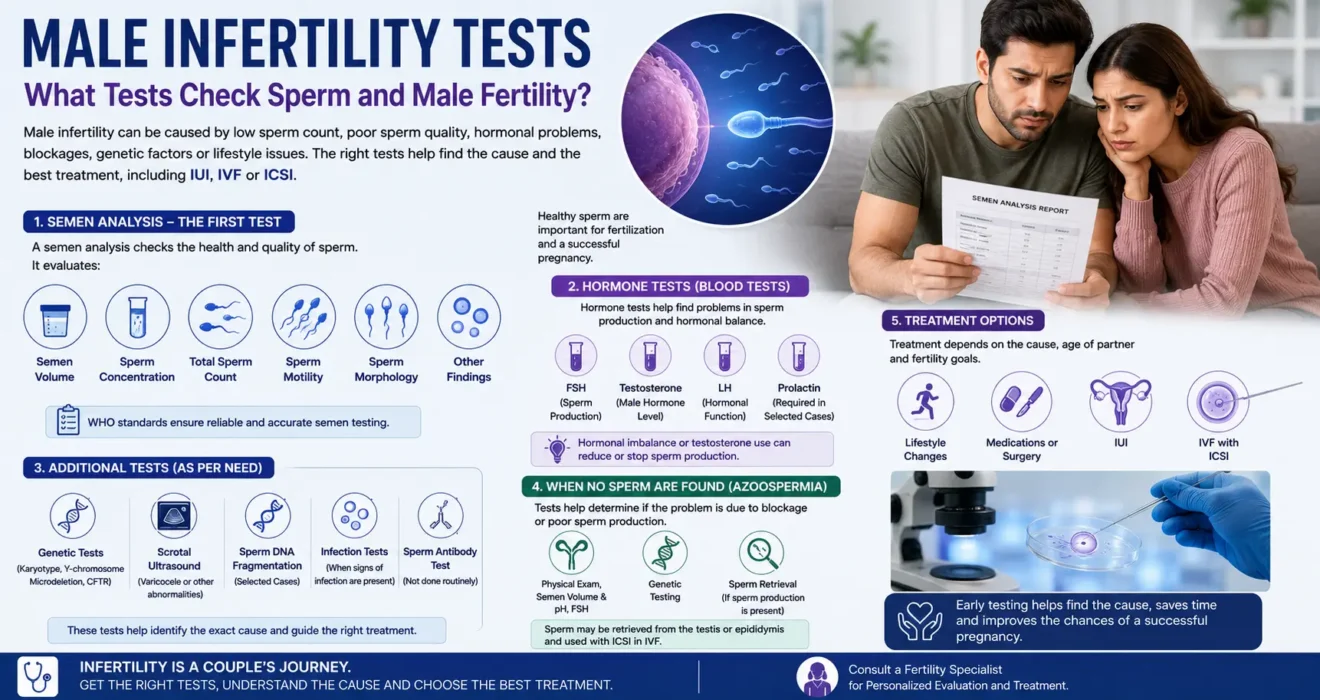
Male Infertility Tests: What Tests Check Sperm and Male Fertility?
If you and your partner have been trying to conceive without success, fertility testing should not be focused only on the woman.
Male factors can contribute to infertility, and checking the male partner early can prevent unnecessary delays in treatment.
Many couples are surprised to learn that the first male fertility test is usually quite simple: a semen analysis.
But a semen analysis is only the beginning when the result is abnormal.
Depending on the sperm count, motility, morphology, medical history and physical examination, a fertility specialist may recommend hormone tests, genetic tests, ultrasound or other investigations.
If you are planning IUI, IVF or ICSI, knowing what is causing the sperm problem can also help your doctor decide which treatment is most appropriate.
The important thing to remember is that one abnormal semen report does not mean that a man cannot become a father.
Sperm parameters can vary between samples. The AUA/ASRM guideline recommends using semen analysis to guide further evaluation and notes that results are more clinically significant when several sperm parameters are abnormal rather than just one. When the first semen analysis is abnormal, repeat testing is often recommended.
The World Health Organization also emphasizes standardized semen testing and explains that semen analysis cannot, by itself, determine whether an individual man or couple is fertile or infertile. Fertility depends on the couple as a whole.
Why Should Men Be Tested for Infertility?
When a couple is unable to conceive, both partners should be evaluated.
Infertility can be related to:
Male factors
Female factors
A combination of male and female factors
Sometimes no clearly identified cause
The AUA/ASRM guideline recommends that male and female partners undergo evaluation at the same time rather than investigating only one partner. The initial male evaluation includes a reproductive history and one or more semen analyses.
This is important because a couple may spend months investigating the woman’s fertility while an easily identifiable male factor remains undiagnosed.
A simple semen analysis can sometimes provide the first important clue.
When Should a Man Have a Fertility Test?
Male fertility testing should be considered when a couple has been trying to conceive without success.
Testing becomes particularly important if there is a history of:
Low sperm count
Previous abnormal semen analysis
Testicular surgery
Undescended testicle
Testicular injury
Varicocele
Testicular infection
Mumps affecting the testicles
Chemotherapy or radiation
Testosterone treatment
Anabolic steroid use
Erectile problems
Ejaculation problems
Very low libido
Previous IVF or ICSI failure
Recurrent pregnancy loss
Men with abnormal semen parameters should be evaluated by a clinician experienced in male reproductive health for a detailed history, physical examination and appropriate additional tests.
What Is the First Test for Male Infertility?
Semen Analysis
Semen analysis is usually the first important test for male infertility.
The test examines a semen sample and provides information about the sperm and semen.
It commonly evaluates:
Semen volume
Sperm concentration
Total sperm number
Sperm motility
Sperm morphology
Other semen characteristics
The WHO’s sixth edition laboratory manual provides standardized procedures for semen examination so that laboratories can produce more reliable and comparable results.
But it is important not to look at one number in isolation.
A man with a low sperm count can still sometimes achieve a pregnancy naturally.
Similarly, a man with a normal sperm count can still have fertility problems if other factors are abnormal.
This is why your doctor looks at the whole semen report and the couple’s fertility history.
What Does a Semen Analysis Check?
A semen analysis gives information about several aspects of sperm health.
1. Sperm Count
Sperm count refers to the number of sperm in the semen.
A low sperm count is commonly called oligozoospermia.
A lower sperm count can reduce the chance of natural conception, especially when other sperm parameters are also abnormal.
But sperm count alone does not decide whether a man can father a child.
Your doctor will also consider motility, morphology, total sperm number and the female partner’s fertility.
2. Sperm Concentration
Sperm concentration means the number of sperm present in a specific volume of semen.
It is different from the total number of sperm in the entire ejaculate.
Both can be reported on a semen analysis.
3. Sperm Motility
Motility describes how sperm move.
Sperm need appropriate movement to travel through the female reproductive tract and reach the egg.
Low sperm motility is called asthenozoospermia.
Your report may divide sperm into different motility categories.
Your fertility specialist will interpret these results together with the other semen parameters rather than judging fertility from motility alone.
4. Sperm Morphology
Morphology refers to the shape and structure of sperm.
A semen report may show the percentage of sperm with normal morphology.
Abnormal morphology may be called teratozoospermia.
A low morphology percentage does not automatically mean that pregnancy is impossible.
The AUA/ASRM guideline notes that individual semen parameters are not highly predictive of fertility on their own. The findings become more meaningful when several parameters are abnormal.
5. Semen Volume
Semen volume is the amount of semen produced during ejaculation.
A low semen volume can sometimes be associated with problems involving ejaculation, hormone function, collection or obstruction.
If there is no sperm in the semen, semen volume and other findings can help the doctor understand whether a blockage may be present.
6. Other Findings
A semen analysis may also provide information about:
Round cells
White blood cells
Semen appearance
Liquefaction
Other laboratory characteristics
Additional tests may be performed when the initial report suggests a particular problem.
How Is a Semen Analysis Done?
The sample is usually collected by masturbation into a sterile container supplied by the laboratory.
The laboratory will provide instructions before the test.
Follow these instructions carefully because collection and handling can affect the result.
If some of the sample is accidentally lost, tell the laboratory.
The sample is then examined using standardized laboratory methods.
The WHO recommends standardized procedures and quality control for semen analysis to improve the reliability of results.
Is One Semen Analysis Enough?
Not always.
Sperm production can vary, so one semen analysis may not represent a man’s usual sperm parameters.
If the first report is abnormal, your doctor may recommend another test.
The AUA/ASRM guideline states that when the first semen analysis is abnormal, at least two analyses, ideally separated by about a month, are important for a better assessment.
So if your first report shows low sperm count or poor motility, do not immediately assume that the result represents your permanent fertility status.
A repeat test may provide a clearer picture.
What Does a Low Sperm Count Mean?
A low sperm count means that fewer sperm are present than expected based on the laboratory’s reference values.
It may reduce the chances of natural conception.
But the effect depends on:
How low the count is
Sperm motility
Sperm morphology
Total sperm number
Duration of infertility
Female partner’s age
Female partner’s ovarian reserve
Fallopian tube function
Other fertility factors
A mildly abnormal semen analysis is very different from severe oligozoospermia or azoospermia.
What Causes Low Sperm Count?
There are many possible causes.
These can include:
Varicocele
Hormonal problems
Testicular disorders
Undescended testicle
Previous testicular injury
Certain infections
Genetic conditions
Blockage of the reproductive tract
High fever or severe illness
Certain medicines
Testosterone treatment
Anabolic steroids
Chemotherapy
Radiation
Some lifestyle factors
Sometimes no clear cause is identified.
This is why the goal of testing is not simply to say “your sperm count is low.”
The more useful question is:
“Why is the sperm count low, and can the problem be treated or managed?”
What Is Azoospermia?
Azoospermia means that no sperm are found in the ejaculate.
This can be alarming for a couple.
But azoospermia does not always mean that sperm are completely absent from the testicles.
There are two broad situations.
Obstructive azoospermia means sperm may be produced in the testicles but cannot reach the semen because of a blockage.
Non-obstructive azoospermia means sperm production itself is significantly impaired.
The AUA/ASRM guideline recommends evaluating men with azoospermia using the physical examination, semen volume, semen pH and FSH, among other findings, to help distinguish obstruction from impaired sperm production.
This distinction is important because the treatment options can be very different.
Blood Tests for Male Infertility
Not every man needs extensive blood testing.
Hormone tests are recommended when there are specific symptoms, abnormal semen findings or signs of hormonal problems.
Commonly considered hormones include:
FSH
Testosterone
LH
Prolactin
Additional hormone testing may be considered depending on the situation.
The AUA/ASRM guideline recommends hormonal evaluation with FSH and testosterone in infertile men with conditions such as impaired libido, erectile dysfunction, oligozoospermia, azoospermia, testicular atrophy or other signs of hormonal abnormality.
What Does FSH Tell Us?
FSH, or follicle-stimulating hormone, is involved in sperm production.
An elevated FSH can sometimes indicate that the testicles are having difficulty producing sperm.
FSH can be particularly useful when sperm count is extremely low or sperm are absent.
It should not be interpreted by itself.
Your doctor will consider FSH along with:
Semen analysis
Testicular size
Testosterone
Medical history
Physical examination
Other hormone results
What Does Testosterone Tell Us?
Testosterone is an important male reproductive hormone.
Low testosterone may be associated with:
Reduced libido
Erectile problems
Fatigue
Hormonal abnormalities
Reduced sperm production
However, there is an important point that every man trying to conceive should know:
Taking testosterone from outside the body can suppress sperm production.
Testosterone treatment can reduce the hormonal signals required for sperm production and, in some men, sperm production may become extremely low or stop.
If you are taking testosterone and want to have a child, discuss your fertility plans with a doctor before making any changes to treatment.
Is LH Tested for Male Infertility?
LH, or luteinizing hormone, may be tested when there is concern about hormonal function.
It can help doctors understand how the brain, pituitary gland and testicles are communicating.
LH is particularly useful when testosterone is low and the doctor needs to understand the possible reason.
It is not necessary for every man with infertility.
Is Prolactin Tested in Male Infertility?
Prolactin is also not required for every man.
It may be tested when there are specific symptoms or hormone abnormalities, such as low testosterone with a low or low-normal LH level, reduced libido or other signs suggesting hormonal dysfunction.
If prolactin is elevated, your doctor may investigate the cause.
Physical Examination for Male Infertility
Fertility evaluation is more than a laboratory report.
A male fertility specialist may examine:
Testicular size
Testicular consistency
Epididymis
Vas deferens
Scrotum
Presence of varicocele
Signs of hormonal problems
Your doctor may also ask about:
Previous surgeries
Testicular injury
Undescended testicles
Previous infections
Mumps
Sexual function
Ejaculation
Medications
Testosterone use
Steroid use
Smoking
Alcohol
Previous chemotherapy or radiation
Family history
A detailed reproductive history and physical examination are part of the recommended evaluation when male infertility is suspected.
What Is a Varicocele?
A varicocele is an enlargement of the veins around the testicle.
It is sometimes described as similar to varicose veins.
A clinically significant varicocele can be associated with impaired sperm production in some men.
Not every varicocele requires treatment.
Your doctor may consider treatment when a clinically detectable varicocele is present together with infertility and abnormal semen parameters, depending on the individual situation.
Routine imaging simply to look for small varicoceles that cannot be felt during examination is not recommended as part of the initial evaluation.
Is Testicular Ultrasound Needed?
Not for every man.
A scrotal or testicular ultrasound may be recommended when there is a specific reason, such as:
Suspected varicocele
Testicular lump
Pain or swelling
Abnormal physical examination
Other suspected testicular conditions
Routine scrotal ultrasound is not recommended for every man as the first step in infertility evaluation.
This is an important point because more testing does not always mean better testing.
The right test is the one that answers a specific medical question.
Genetic Tests for Male Infertility
Genetic testing may be important when sperm production is severely impaired.
Depending on the situation, testing may include:
Karyotype
Y-chromosome microdeletion testing
CFTR testing
Other genetic tests when clinically indicated
Genetic testing can help identify the reason for severe male infertility and may also provide information that is important before IVF and ICSI.
What Is a Karyotype Test?
A karyotype examines the number and structure of chromosomes.
Certain chromosomal conditions can affect sperm production.
One example is Klinefelter syndrome, where a man has an extra X chromosome.
The AUA/ASRM guideline recommends karyotype testing in selected men with primary infertility, azoospermia or very low sperm concentration when there are additional findings such as elevated FSH, testicular atrophy or impaired sperm production.
If a genetic abnormality is identified, genetic counseling can help explain what it means for fertility treatment and future pregnancy.
What Is Y-Chromosome Microdeletion Testing?
Certain regions of the Y chromosome contain genes involved in sperm production.
A deletion in these regions can result in severe sperm production problems.
Y-chromosome microdeletion testing may therefore be recommended in selected men with severe oligozoospermia or azoospermia.
The result can also help doctors understand the likelihood of finding sperm during surgical sperm retrieval in some situations.
What Is CFTR Testing?
CFTR testing may be recommended when a man has congenital absence of the vas deferens or certain forms of obstructive azoospermia.
The vas deferens are tubes that transport sperm from the testicles.
Some men are born without one or both vas deferens.
In this situation, genetic testing can be important for both fertility planning and understanding potential genetic implications for the couple.
The AUA/ASRM guideline recommends CFTR mutation testing in men with vasal agenesis or idiopathic obstructive azoospermia and recommends appropriate evaluation of the female partner if a CFTR mutation is identified.
Is Sperm DNA Fragmentation Testing Necessary?
No, not for every man.
Sperm DNA fragmentation testing measures damage to the DNA inside sperm.
It is sometimes promoted as a test that every infertile man should have.
That is not the current approach.
The AUA/ASRM guideline does not recommend sperm DNA fragmentation testing as part of the initial routine evaluation of every infertile man. It may have a role in selected situations, including certain couples with recurrent pregnancy loss.
If you are considering this test, ask your fertility specialist what specific question the result would answer in your case.
When May Sperm DNA Fragmentation Testing Be Considered?
Your doctor may consider it in selected situations such as:
Recurrent pregnancy loss
Certain unexplained fertility problems
Previous fertility treatment problems
Other clinical situations where sperm DNA damage may be relevant
It should not automatically replace the basic evaluation.
Semen analysis remains the starting point for most men.
What Is Sperm Vitality Testing?
Sperm vitality tells us whether sperm are alive or dead.
This can be useful when sperm movement is extremely poor.
A sperm that does not move may still be alive, so vitality testing can provide additional information in selected cases.
It is generally not a routine first-line test for every man.
What Are Round Cells in Semen?
A semen report may sometimes show round cells.
These can include immature sperm cells or white blood cells.
If the number is elevated, your doctor may need to determine what type of cells are present.
If white blood cells are found, the doctor may investigate possible infection or inflammation.
The AUA/ASRM guideline recommends further evaluation when pyospermia, meaning an increased number of white blood cells in semen, is identified.
Are Infection Tests Needed?
Not routinely.
Testing for infection is generally considered when symptoms or semen findings suggest an infection or inflammation.
Depending on the situation, your doctor may recommend additional laboratory testing.
The important point is that infection testing should be based on clinical findings rather than automatically ordered for every infertile man.
Are Antisperm Antibody Tests Needed?
Antisperm antibody testing is not routinely recommended as part of the initial evaluation of male infertility.
It may be considered in selected situations when the result could change treatment.
This is another example of why fertility testing should be targeted rather than based on a long list of tests.
What Tests Are Done When There Is No Sperm?
When azoospermia is found, the evaluation usually becomes more detailed.
Your doctor may consider:
Repeat semen analysis
Physical examination
Semen volume
Semen pH
FSH
Testosterone
LH when indicated
Genetic testing
Assessment for obstruction
Imaging in selected cases
The main question is:
Is sperm being produced but unable to reach the semen, or is sperm production itself reduced?
The answer can significantly change the treatment plan.
Can Sperm Be Retrieved if There Is No Sperm in Semen?
Sometimes, yes.
In selected men with azoospermia, sperm can be retrieved from the epididymis or testicle.
If usable sperm are found, they may be used with ICSI as part of IVF.
Whether sperm retrieval is possible depends on the underlying cause of azoospermia.
Therefore, an azoospermia diagnosis should not immediately be interpreted as “there is no possibility of biological fatherhood.”
A proper male fertility evaluation is important first.
What Is ICSI?
ICSI stands for intracytoplasmic sperm injection.
It is a technique used during IVF in which a single sperm is injected directly into an egg.
ICSI may be useful when there is significant male factor infertility.
It may be considered when:
Sperm count is extremely low.
Sperm motility is very poor.
Surgically retrieved sperm are being used.
There was previous failure of fertilization with conventional IVF.
There are certain severe sperm abnormalities.
ICSI is not automatically required for every man with a slightly abnormal semen analysis.
The decision should be based on the couple’s circumstances and the fertility team’s assessment.
Male Infertility Tests Before IVF
Before IVF, the male partner may need:
Basic evaluation
Medical history
Reproductive history
Physical examination
Semen analysis
Additional testing when indicated
Repeat semen analysis
FSH
Testosterone
LH
Prolactin
Genetic testing
Scrotal ultrasound
Selected sperm function tests
The exact tests depend on the semen report, medical history and treatment plan.
The AUA/ASRM recommendations support targeted evaluation based on the patient’s findings rather than ordering every possible test for everyone.
Does Male Infertility Affect IVF?
Male infertility can make fertilization more difficult, but IVF and ICSI provide important treatment options.
If sperm count is low or sperm movement is poor, the laboratory team can select available sperm for treatment.
If sperm are not present in the ejaculate but can be retrieved surgically, those sperm may sometimes be used for ICSI.
This means that even severe male factor infertility does not automatically mean that IVF cannot work.
At the same time, the underlying cause of male infertility should still be investigated.
Does Low Sperm Count Mean IVF Is Necessary?
No.
A low sperm count does not automatically mean that IVF is required.
Treatment depends on:
Sperm concentration
Total sperm number
Motility
Morphology
Female partner’s age
Ovarian reserve
Fallopian tube status
Duration of infertility
Other medical factors
Mild male factor infertility may sometimes be managed with timed intercourse or IUI, depending on the couple.
More severe sperm abnormalities may make IVF with ICSI a better option.
Male Infertility and IUI
IUI, or intrauterine insemination, may be considered for selected couples with mild male factor infertility.
During IUI, sperm are processed in the laboratory and the prepared sperm sample is placed directly into the uterus around the time of ovulation.
IUI may be considered when there is an adequate number of usable sperm after processing and no major female fertility problem.
If sperm numbers are extremely low or motility is severely impaired, IVF with ICSI may be more appropriate.
Male Infertility and IVF With ICSI
IVF with ICSI can be particularly useful when sperm-related problems are severe.
It may be considered when:
Sperm count is extremely low.
Motility is severely reduced.
There is azoospermia with retrievable sperm.
Previous IVF had poor fertilization.
Surgically retrieved sperm are being used.
ICSI helps overcome one important step in fertilization by placing a sperm directly into the egg.
It does not, however, remove the underlying cause of male infertility.
If there is a hormonal, genetic or testicular problem, that issue still needs appropriate evaluation.
Can Male Infertility Be Treated Without IVF?
Sometimes.
Treatment depends on the cause.
Some men may benefit from:
Treatment of hormonal problems
Treatment of infections when present
Varicocele treatment in selected cases
Treatment of certain obstructions
Changing medications that are affecting fertility
Addressing testosterone or anabolic steroid use
Lifestyle changes
Other men may benefit from IUI, IVF or ICSI.
Finding the cause is therefore important before deciding on treatment.
Does Testosterone Treatment Cause Infertility?
This is one of the most important things men trying to conceive should know.
External testosterone can suppress sperm production.
Testosterone treatment reduces the hormonal signals that stimulate sperm production inside the testicles.
In some men, sperm production can become extremely low or stop.
The AUA/ASRM guideline recommends that men interested in current or future fertility should not be prescribed testosterone monotherapy because of its effect on sperm production.
If you are taking testosterone for low testosterone and want to become a father, discuss your fertility goals with a doctor who understands male reproductive health.
Do not stop prescribed medication without medical advice.
Do Anabolic Steroids Affect Sperm?
Yes.
Anabolic steroids can suppress the body’s natural hormone signals required for sperm production.
This can lead to:
Low sperm count
Very poor sperm production
Azoospermia
Some men assume that high testosterone automatically means better fertility.
It does not.
Testosterone levels and sperm production are related, but taking testosterone from outside the body can actually reduce sperm production.
If you use anabolic steroids and are planning a pregnancy, tell your fertility specialist.
Can Lifestyle Affect Sperm Quality?
Yes.
Male reproductive health can be influenced by several lifestyle and health factors.
These may include:
Smoking
Heavy alcohol use
Obesity
Recreational drug use
Anabolic steroids
Certain medicines
Poor sleep
Some environmental exposures
Severe illness
High fever
Improving lifestyle can be helpful, but it should not become a reason to delay medical evaluation when infertility is already present.
If the semen analysis is significantly abnormal, finding the cause is more important than relying only on supplements or lifestyle changes.
Can Fever Affect Sperm Count?
Yes.
A significant fever or illness can temporarily affect sperm production.
Because sperm production takes time, an abnormal semen analysis after a recent illness may not reflect the man’s usual sperm parameters.
This is another reason your doctor may recommend repeat testing.
Tell your fertility specialist if you had a high fever or significant illness before the semen analysis.
Do Male Fertility Supplements Work?
There are many supplements marketed for:
Sperm count
Sperm motility
Sperm morphology
Testosterone
Male fertility
Some contain antioxidants, vitamins or minerals.
But supplements should not replace proper evaluation.
If your semen analysis is abnormal, do not spend months taking supplements without finding out whether there is a medical cause that needs treatment.
Your fertility specialist can tell you whether a particular supplement is appropriate in your situation.
Can Varicocele Cause Male Infertility?
A clinically significant varicocele can affect sperm production in some men.
But not every varicocele needs treatment.
Treatment may be considered when there is a clinically detectable varicocele, infertility and abnormal semen parameters, depending on the individual situation.
A small varicocele that can only be seen on ultrasound does not automatically require treatment.
This is why physical examination is important.
Can Male Infertility Be Genetic?
Yes.
Genetic factors can contribute to severe male infertility.
This becomes particularly important when:
Sperm count is extremely low.
There is azoospermia.
Testicles are small.
FSH is elevated.
Sperm production appears impaired.
There is congenital absence of the vas deferens.
Genetic testing may help identify the cause and may provide important information before IVF and ICSI.
Why Should Both Partners Be Tested?
Infertility is a problem involving a couple, not just one partner.
A couple may have:
Male factor infertility
Female factor infertility
Both male and female factors
No identified cause
The AUA/ASRM guideline recommends concurrent evaluation of both partners because looking at male fertility separately from female fertility can give an incomplete picture.
For example, a man may have a mildly low sperm count while his partner has reduced ovarian reserve.
In that situation, simply treating the sperm count may not be the most effective approach.
The treatment plan should consider the couple as a whole.
What Is the Best Male Infertility Test?
If you are asking for one starting test, it is usually:
Semen analysis.
But the next test depends on what the semen analysis shows.
A man with a normal semen analysis may not need extensive additional testing.
A man with very low sperm count may need hormone and genetic testing.
A man with azoospermia may need a detailed evaluation to determine whether sperm production or sperm transport is the problem.
A man with sexual or ejaculation problems may need a different assessment.
There is no single test that can answer every male fertility question.
Male Infertility Tests at a Glance
| Test | Why It May Be Done |
|---|---|
| Semen analysis | Checks sperm concentration, total number, motility, morphology and semen characteristics |
| Repeat semen analysis | Confirms an abnormal first result |
| Physical examination | Looks for varicocele, testicular abnormalities and problems with the reproductive tract |
| FSH | Helps assess sperm production and hormonal function |
| Testosterone | Evaluates male hormonal function |
| LH | Helps investigate selected hormonal problems |
| Prolactin | Used in selected men with hormonal or sexual symptoms |
| Scrotal ultrasound | Used when there is a specific clinical indication |
| Karyotype | Used in selected men with severe sperm production problems |
| Y-chromosome microdeletion test | Used in selected men with severe oligozoospermia or azoospermia |
| CFTR testing | Used in selected men with vasal agenesis or obstructive azoospermia |
| Sperm DNA fragmentation | Considered in selected cases, not as a routine first test |
| Sperm retrieval | Considered in selected men with azoospermia |
The appropriate tests depend on the individual patient’s history, physical examination and semen results.
When Should a Man See a Male Fertility Specialist?
You should consider seeing a male fertility specialist or reproductive urologist if:
Your semen analysis is abnormal.
Your sperm count is very low.
No sperm are found in the semen.
You have a history of testicular surgery.
You had an undescended testicle.
You have a suspected varicocele.
You have erectile problems.
You have ejaculation problems.
You are taking testosterone.
You have used anabolic steroids.
You have undergone chemotherapy or radiation.
You are preparing for IVF because of male factor infertility.
You have experienced repeated IVF failure.
Your partner has experienced recurrent pregnancy loss.
The AUA/ASRM guideline recommends specialist evaluation for men with abnormal semen parameters or presumed male infertility.
What Happens After Male Infertility Testing?
The next step depends on the results.
If the semen analysis is normal:
Your doctor may continue evaluating other possible causes of infertility.
If sperm count is mildly low:
Repeat testing and evaluation of possible causes may be recommended.
If several semen parameters are abnormal:
A detailed male fertility evaluation becomes more important.
If sperm count is extremely low:
Hormone and genetic testing may be recommended.
If there is azoospermia:
Your doctor will determine whether the problem is related to obstruction or impaired sperm production.
If there is significant male factor infertility:
IUI, IVF or ICSI may be discussed.
An abnormal semen report is therefore not the end of the fertility journey.
It is information that helps your doctor decide what should happen next.
Can IVF Help With Male Infertility?
Yes.
IVF can help couples where sperm problems make natural conception difficult.
When sperm quality is significantly affected, ICSI can be used as part of IVF.
During ICSI, one sperm is injected directly into an egg.
This can be especially useful when only a small number of sperm are available or when sperm have to be retrieved surgically.
The AUA/ASRM guideline includes IVF and ICSI among the treatment options for male factor infertility.
Does Low Sperm Count Mean IVF Is the Only Option?
No.
A low sperm count does not automatically mean IVF.
Mild abnormalities may sometimes be managed with timed intercourse or IUI, depending on the couple.
IVF with ICSI becomes more relevant when sperm abnormalities are severe or when other fertility factors are present.
The decision also depends heavily on the female partner’s age and ovarian reserve.
If the female partner is older or has reduced ovarian reserve, delaying treatment may not be helpful simply to try several less effective options first.
What Should Couples Ask Before IVF?
If male infertility has been identified, ask your fertility specialist:
What exactly is abnormal in the semen report?
Is the sperm count mildly or severely reduced?
Is motility also affected?
Is sperm morphology a concern?
Do we need a repeat semen analysis?
Do I need hormone testing?
Could there be a varicocele?
Do I need genetic testing?
Could testosterone or another medicine be affecting my sperm?
Is IUI reasonable in our situation?
Would IVF be a better option?
Do we need ICSI?
If there is azoospermia, can sperm be retrieved?
Are there fertility factors affecting my partner as well?
Would delaying IVF affect our chances?
These questions can help you understand why a particular treatment is being recommended.
Conclusion
Male infertility testing should start with the right test, not every possible test.
For most couples, the first important investigation is a semen analysis.
If the result is abnormal, repeating the test and looking at the complete picture can help determine whether the problem is temporary, mild, severe or related to an underlying condition.
Depending on the findings, your fertility specialist may recommend hormone testing, physical examination, genetic testing, ultrasound or selected sperm tests.
Not every man needs every fertility test.
If sperm count is very low or no sperm are found, additional evaluation becomes particularly important. Some causes can be treated, while others may still allow biological fatherhood through sperm retrieval and IVF with ICSI.
Most importantly, do not assume that an abnormal semen report means you cannot become a father.
Male infertility is often manageable, and modern fertility treatment provides several options depending on the cause and severity of the problem.
If you and your partner have been trying to conceive, getting the male fertility evaluation early can save valuable time and help your doctor choose the right treatment.
The goal is not simply to find an abnormal number. The goal is to understand what is causing the problem and choose the treatment that gives your couple the best chance of pregnancy.
About Dr. Shipra Singla
Dr. Shipra Singla is an infertility and IVF specialist helping couples understand the causes of infertility and choose fertility treatment according to their individual needs.
If you have low sperm count, poor sperm motility, abnormal sperm morphology, azoospermia, repeated IVF failure or difficulty conceiving, a proper male fertility evaluation can help identify the next step.
Male infertility does not always mean that biological fatherhood is impossible. With the right evaluation and timely treatment, many couples have options.
Frequently Asked Questions About Male Infertility Tests
What is the first test for male infertility?
Semen analysis is generally the first important test for evaluating male fertility.
What does a semen analysis check?
It evaluates semen and sperm characteristics including concentration, total number, motility and morphology. The WHO provides standardized laboratory methods for semen testing.
Is one semen analysis enough?
Not always. If the first result is abnormal, repeat testing may be recommended because sperm parameters can vary.
What blood tests are done for male infertility?
FSH and testosterone are commonly considered when hormonal evaluation is indicated. LH, prolactin and other tests may be added depending on the patient’s symptoms and findings.
What test is done for low sperm count?
The first test is a semen analysis. If the sperm count is significantly low, your doctor may recommend repeat semen analysis, hormone testing, physical examination and sometimes genetic testing.
What tests are done for azoospermia?
Evaluation may include repeat semen analysis, physical examination, semen volume, semen pH, FSH, testosterone and genetic testing when indicated.
Can a man with no sperm have a biological child?
In selected cases, yes. If sperm can be retrieved from the epididymis or testicle, it may be used with ICSI. Whether this is possible depends on the cause of azoospermia.
Is sperm DNA fragmentation testing necessary for every man?
No. It is not recommended as a routine first-line test for every infertile man. It may be considered in selected situations.
Is testicular ultrasound required for every man?
No. Routine scrotal ultrasound is not recommended as the initial evaluation for every infertile man. It may be useful when there is a specific clinical indication.
Can varicocele cause infertility?
A clinically significant varicocele can affect sperm production in some men. Whether it needs treatment depends on the examination, semen results and fertility situation.
Can testosterone cause low sperm count?
Yes. External testosterone can suppress the hormonal signals required for sperm production and may cause very low sperm counts or azoospermia.
Can anabolic steroids cause infertility?
Yes. Anabolic steroids can suppress natural sperm production and may lead to very low sperm counts or azoospermia.
Can low sperm count be treated?
Sometimes. Treatment depends on the underlying cause. Some men may benefit from medical treatment, surgery or lifestyle changes, while others may need IUI, IVF or ICSI.
Can IVF help with low sperm count?
Yes. IVF with ICSI can be useful when sperm abnormalities are severe.
Can IVF work if there is azoospermia?
In selected cases, sperm can be retrieved surgically and used with ICSI. The possibility depends on whether sperm production is present and why sperm are absent from the semen.
What genetic tests are done for male infertility?
Depending on the clinical findings, tests can include karyotype, Y-chromosome microdeletion testing and CFTR testing.
Why should both partners be tested?
Because infertility may be caused by male factors, female factors or both. AUA/ASRM recommends concurrent evaluation of both partners.
Can an abnormal semen report improve?
Sometimes. The answer depends on the cause. Treating an underlying condition, changing an infertility-related medication under medical guidance or addressing certain lifestyle factors may improve sperm parameters in selected men.
Does low sperm count always require ICSI?
No. ICSI is generally considered when there is significant male factor infertility or another specific reason. A mildly abnormal semen analysis does not automatically mean ICSI is required.