
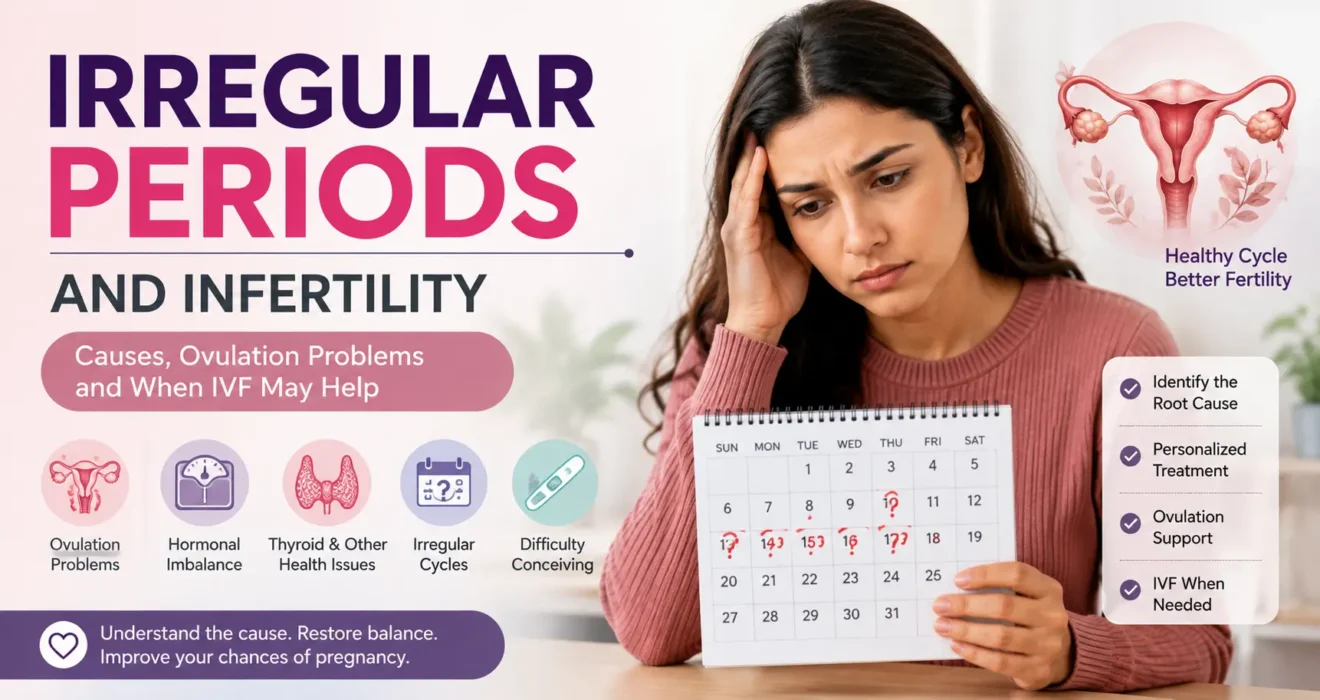
Irregular Periods and Infertility: Causes, Ovulation Problems and When IVF May Help
Are your periods coming at different times every month? Sometimes after 25 days, then 35 days, then 45 days? Or do you skip your period for one or two months?
If you are trying to get pregnant, irregular periods should not be ignored.
Irregular periods do not always mean infertility. However, they can be a sign that you are not ovulating regularly, and irregular or absent ovulation can make it more difficult to conceive. Conditions such as PCOS, thyroid problems, significant weight changes, excessive exercise, stress and other hormonal problems can affect the menstrual cycle and ovulation.
For women trying to conceive, the important question is not simply, “Why are my periods irregular?”
It is:
“Am I ovulating regularly, and what is causing my irregular periods?”
Finding the cause can make a major difference to your fertility treatment.
Some women with irregular periods become pregnant naturally after the underlying problem is treated. Others may need medicines to help ovulation. In some situations, IUI or IVF may be recommended, particularly when there are additional fertility factors or when previous treatments have not worked.
This article explains the connection between irregular periods and infertility, common causes, how doctors evaluate irregular cycles, treatment options and when IVF may be considered.
What Are Irregular Periods?
A menstrual cycle is counted from the first day of one period to the first day of the next period.
For most adult women, menstrual cycles generally occur every 21 to 35 days. Some variation from month to month can be normal.
Your periods may be considered irregular when:
- Your cycle length changes significantly from month to month.
- Your periods frequently come less than 21 days apart.
- Your periods frequently come more than 35 days apart.
- You skip periods.
- You may go several months without a period.
- Your periods suddenly become irregular after previously being predictable.
- You have bleeding between periods.
- Your periods are unusually heavy or last longer than 7 days.
ACOG advises evaluation when periods that were previously regular become irregular, when periods occur more often than every 21 days or less often than every 45 days, or when there are gaps of more than 90 days between periods.
For a woman who is trying to conceive, irregular cycles are particularly important because they can make it difficult to know when ovulation is happening.
Can Irregular Periods Cause Infertility?
Irregular periods do not directly cause infertility in every woman.
The bigger concern is irregular ovulation.
Ovulation is the process in which an ovary releases an egg. Pregnancy can occur when sperm fertilizes an egg around the time of ovulation.
If you do not ovulate regularly, there may be fewer opportunities to conceive.
According to the American Society for Reproductive Medicine, ovulatory dysfunction accounts for a significant proportion of infertility in women and commonly presents with menstrual disturbances such as oligomenorrhea or amenorrhea.
This means that if your periods are very irregular, your fertility specialist will usually want to understand whether you are ovulating and why ovulation may be irregular.
The good news is that many causes of irregular ovulation can be treated.
Irregular Periods and Ovulation
This is the most important connection between your periods and fertility.
A regular menstrual cycle often suggests regular ovulation, although it is not an absolute guarantee.
On the other hand, very irregular periods can indicate that ovulation is happening infrequently or not happening at all.
For example, if your periods come every 45 to 60 days, you may be ovulating only occasionally.
This means you have fewer fertile opportunities during the year.
A woman may think:
“I am getting my periods, so I must be ovulating.”
But having menstrual bleeding does not always mean that ovulation occurred normally.
That is why fertility evaluation focuses on the underlying cause rather than simply trying to make the periods regular.
What Causes Irregular Periods?
There are many possible causes of irregular menstrual cycles.
Some of the most common causes relevant to women trying to conceive include:
1. PCOS
Polycystic ovary syndrome (PCOS) is one of the most common causes of irregular periods and ovulation problems.
Women with PCOS may experience:
Irregular periods
Long menstrual cycles
Missed periods
Difficulty getting pregnant
Acne
Increased facial or body hair
Weight gain or difficulty losing weight
Polycystic-appearing ovaries on ultrasound
However, not every woman with PCOS has all of these symptoms.
PCOS can affect ovulation, which is why it is an important cause of infertility.
If you have PCOS and are trying to conceive, treatment is not simply about getting your period every month.
The goal is to restore or achieve regular ovulation and improve your chances of pregnancy.
2. Thyroid Problems
The thyroid gland plays an important role in many body functions, including reproductive health.
Both underactive and overactive thyroid disorders can affect menstrual cycles and ovulation.
If you have irregular periods along with symptoms such as tiredness, unexplained weight changes, feeling unusually cold or hot, hair changes or other thyroid-related symptoms, your doctor may recommend thyroid testing.
Treating an underlying thyroid problem can sometimes help restore more normal menstrual function and improve fertility.
3. Weight Gain or Weight Loss
Significant changes in body weight can affect reproductive hormones.
Being significantly underweight, losing weight quickly or gaining substantial weight may interfere with ovulation.
This does not mean that every woman with a higher or lower body weight will have fertility problems.
The important issue is whether changes in weight are affecting hormonal function and ovulation.
4. Excessive Exercise
Very intense exercise, particularly when combined with inadequate calorie intake or low body weight, can interfere with the hormonal signals needed for ovulation.
Women who exercise heavily and have very irregular or absent periods should discuss this with their doctor.
5. Stress
Stress can affect menstrual patterns in some women.
Major emotional stress, poor sleep, changes in routine and other lifestyle factors may contribute to menstrual irregularity.
However, it is important not to blame infertility entirely on stress.
If you have been trying to conceive and your periods are irregular, there may be a medical reason that deserves proper evaluation.
6. High Prolactin
Prolactin is a hormone involved in breast milk production.
When prolactin levels are abnormally high, it can interfere with ovulation and cause irregular or absent periods.
Prolactin testing is generally considered when symptoms or menstrual history suggest a possible problem rather than as a routine test for every infertility patient.
7. Perimenopause and Age-Related Changes
As women approach menopause, menstrual cycles may become less predictable.
Fertility also declines with increasing age.
If irregular periods begin later in the reproductive years, your doctor may consider whether age-related ovarian changes could be contributing.
8. Primary Ovarian Insufficiency
In some younger women, irregular or absent periods may be associated with primary ovarian insufficiency (POI).
This is different from ordinary irregular periods and requires medical evaluation.
9. Other Hormonal or Medical Conditions
Other conditions involving the hypothalamus, pituitary gland, ovaries or reproductive system can affect menstrual cycles.
This is why it is not a good idea to assume that every irregular period is caused by PCOS.
Does PCOS Always Mean Infertility?
No.
Many women with PCOS become pregnant.
The main fertility problem in PCOS is often irregular or absent ovulation.
If an egg is not released regularly, it becomes harder to time intercourse and achieve pregnancy.
The treatment approach depends on the individual woman.
For some women, lifestyle changes may be recommended.
For others, medication to induce ovulation may be appropriate.
In some cases, IUI or IVF may be considered.
The important thing is to treat the actual fertility problem rather than simply focusing on the diagnosis of PCOS.
Can I Get Pregnant With Irregular Periods?
Yes.
Having irregular periods does not mean that pregnancy is impossible.
Some women with irregular cycles ovulate occasionally and become pregnant naturally.
However, if your cycles are very irregular, you may have fewer ovulatory opportunities.
You may also find it difficult to predict your fertile window.
If you have been trying to conceive without success, the right next step is to determine whether you are ovulating and identify the reason for the irregular cycles.
How Do Irregular Periods Affect Trying to Conceive?
There are two major problems.
Problem 1: You may not ovulate regularly
If ovulation is unpredictable, you may have fewer opportunities to conceive.
Problem 2: It becomes difficult to identify the fertile window
When cycles are regular, estimating the fertile window is easier.
When cycles change significantly from month to month, calendar-based fertility tracking may be less reliable.
ASRM also notes that fertility tracking apps have limitations in accurately predicting the fertile window.
If you have irregular periods, your fertility specialist may use ultrasound, hormone testing or other methods to understand your ovulation pattern.
How Is Irregular Periods-Related Infertility Diagnosed?
Your doctor will usually start with your medical and menstrual history.
You may be asked:
When did your periods start?
How long is your typical cycle?
What is the shortest cycle you have?
What is the longest cycle you have?
How many days do you bleed?
Do you ever skip periods?
When was your last period?
Do you have acne or excess facial hair?
Have you gained or lost weight recently?
How much do you exercise?
Are you taking any medicines?
Have you previously been pregnant?
How long have you been trying to conceive?
Has your partner had a fertility evaluation?
A fertility evaluation should look at the couple rather than only the woman.
ASRM recommends assessing ovulation, the female reproductive tract and the male partner’s semen as part of infertility evaluation.
What Tests May Be Recommended for Irregular Periods?
Depending on your symptoms and history, your fertility specialist may recommend several investigations.
Pregnancy Test
If you have missed a period and pregnancy is possible, pregnancy should be ruled out first.
Thyroid Testing
A TSH test may be recommended because thyroid disorders can affect menstrual cycles and ovulation.
Prolactin
Prolactin may be checked when there is irregular or absent menstruation, particularly when there are symptoms such as unexpected milk discharge.
Other Hormone Tests
Depending on the situation, your doctor may recommend FSH, estradiol, androgen testing or other hormonal investigations.
The exact tests should be based on your symptoms and clinical findings.
Pelvic Ultrasound
A transvaginal ultrasound can help assess:
Ovaries
Antral follicles
Uterus
Endometrium
Fibroids
Cysts
Polycystic ovarian morphology
Other pelvic abnormalities
Ultrasound may also provide information about follicular development and ovulation.
AMH
AMH may be used as part of ovarian reserve assessment in infertility treatment.
However, AMH should not be used alone to determine whether you can become pregnant.
It is important to remember that AMH and ovulation are different things.
A woman can have normal AMH and irregular ovulation.
A woman can also have low AMH and still ovulate.
Semen Analysis
Your partner should also be evaluated.
Male factor infertility can contribute to difficulty conceiving, and testing both partners helps avoid unnecessary delays.
Tubal Testing
Your doctor may recommend HSG or another appropriate test to check whether the fallopian tubes are open.
ASRM includes evaluation of tubal patency as part of the standard infertility assessment.
Can Irregular Periods Be Treated Without IVF?
Yes.
IVF is not automatically required just because you have irregular periods.
If the main problem is irregular ovulation and there are no major problems with the fallopian tubes or sperm, your doctor may first consider treatment aimed at achieving ovulation.
The treatment depends on the cause.
For example, treatment may involve:
Lifestyle changes where appropriate
Treating thyroid problems
Treating elevated prolactin when present
Ovulation-induction medicines
Timed intercourse
IUI
However, not every woman will benefit from the same treatment.
Your age and the duration of infertility are also important.
When Is IVF Recommended for Irregular Periods?
IVF may be considered when irregular ovulation is combined with other fertility factors or when simpler treatments have not been successful.
Your fertility specialist may discuss IVF if:
Ovulation medicines have not resulted in pregnancy.
IUI has not worked after an appropriate number of attempts.
There is blocked or damaged fallopian tubes.
There is significant male factor infertility.
There are additional ovarian or uterine factors.
Age makes it important to consider a more effective treatment sooner.
You have been trying to conceive for a significant period.
There are other indications for IVF.
ASRM recommends that infertility evaluation should not be unnecessarily delayed when a known condition associated with infertility is already present. It also recommends earlier evaluation in women aged 35 and older and more immediate evaluation in women over 40.
This is particularly important for women who have irregular periods and are also getting older.
IVF for PCOS and Irregular Periods
Women with PCOS may sometimes need IVF when other fertility treatments have not worked or when there are additional indications.
IVF can be an effective fertility treatment, but women with PCOS require careful ovarian stimulation because they may have a higher risk of developing ovarian hyperstimulation syndrome.
The IVF protocol is therefore individualized.
A fertility specialist may carefully monitor follicular growth and hormone levels during stimulation.
The aim is to obtain a suitable number of mature eggs while keeping the treatment as safe as possible.
Do You Need IVF If You Have PCOS?
Not necessarily.
This is a very common concern.
A diagnosis of PCOS does not automatically mean that you need IVF.
If PCOS is causing irregular ovulation and there are no other significant fertility problems, ovulation-induction treatment may be considered first.
However, IVF may become an option if:
Ovulation treatment is unsuccessful.
Other infertility factors are present.
There is a significant male factor.
The fallopian tubes are blocked.
The couple has other reasons to proceed with IVF.
Age and fertility timeline make IVF a more appropriate option.
The best treatment is the one that matches your actual fertility situation.
Irregular Periods After Stopping Birth Control. Should You Worry?
It is common for menstrual patterns to change after stopping hormonal contraception.
However, if your periods remain absent or significantly irregular, it is worth discussing with your doctor, especially if you are trying to conceive.
A missed period should also be evaluated for pregnancy when pregnancy is possible.
Do not assume that all irregular periods after stopping contraception are simply because your body is “taking time to adjust.”
If irregularity continues, the underlying cause should be assessed.
Can You Track Ovulation With Irregular Periods?
You can try, but it can be more difficult.
Ovulation predictor kits detect the LH surge that usually occurs before ovulation.
However, women with PCOS can sometimes have elevated LH levels, which may result in misleading results. ASRM notes that urinary LH tests can produce false-positive and false-negative results and that PCOS may affect their interpretation.
Your fertility specialist may therefore recommend ultrasound monitoring or blood testing when a more accurate assessment of ovulation is needed.
What If My Period Comes Every 40 Days?
A 40-day cycle is longer than the typical 21 to 35 day range for most adult women.
One occasional longer cycle may not necessarily indicate a major fertility problem.
But if your cycles consistently last around 40 days or longer, particularly if you are trying to conceive, it is worth finding out whether you are ovulating regularly.
Long cycles can be associated with conditions such as PCOS or other hormonal issues.
Instead of simply taking medicine to bring on a period, it is better to understand why the cycle is long.
What If I Get My Period Only Every 2 or 3 Months?
If you have periods only every few months, you may not be ovulating regularly.
This can make pregnancy more difficult.
ASRM considers oligomenorrhea and amenorrhea important reasons for fertility evaluation, and ACOG advises medical evaluation when periods are absent for three months or more without explanation.
If you are trying to conceive, do not wait indefinitely for your periods to become regular on their own.
A fertility evaluation can identify the underlying cause and help determine the appropriate treatment.
Can Irregular Periods Affect IVF?
Yes, but irregular periods do not necessarily prevent IVF.
IVF does not depend on you having a naturally regular menstrual cycle in the same way that timed intercourse does.
Your fertility specialist can use medication and monitoring to control the timing of ovarian stimulation and egg retrieval.
The treatment plan will depend on:
Your age
Ovarian reserve
AFC
Hormone levels
PCOS or other conditions
Previous IVF history
Sperm quality
Uterine health
Previous pregnancies
Your overall fertility history
For many women with irregular periods, IVF can therefore still be an option.
Does Irregular Periods Mean Poor Egg Quality?
No.
Irregular periods mainly raise concern about ovulation and hormonal function.
They do not automatically mean that your eggs are poor quality.
Egg quality is strongly influenced by age.
A younger woman with irregular periods due to PCOS may still have good egg quality.
Similarly, a woman with regular periods can experience age-related decline in egg quality.
This distinction is important when discussing IVF.
Can Lifestyle Changes Help Irregular Periods?
Lifestyle changes can be helpful in some situations, particularly when weight, excessive exercise, poor nutrition or other lifestyle factors are contributing to menstrual irregularity.
However, lifestyle advice should be individualized.
You do not need to blame yourself for irregular periods.
If your periods are irregular because of PCOS, thyroid disease, ovarian problems or another medical condition, lifestyle changes alone may not solve the problem.
A healthy lifestyle should support fertility treatment, not replace appropriate medical evaluation.
What Should I Do If I Have Irregular Periods and Want a Baby?
If you are trying to conceive and your periods are irregular, start by understanding your cycle.
Keep a record of:
First day of each period
Number of days you bleed
Longest cycle
Shortest cycle
Missed periods
Bleeding between periods
Pain during periods
Any unusual symptoms
Also note symptoms such as:
Acne
Excess facial hair
Unexplained weight changes
Hair thinning
Milk discharge from the breasts
Pelvic pain
Hot flashes
This information can help your fertility specialist identify possible causes.
Most importantly, do not rely only on period-tracking apps to determine whether you are ovulating if your cycles are significantly irregular.
When Should You See an IVF Specialist?
If you are trying to conceive and have irregular periods, you may benefit from fertility evaluation sooner rather than later.
You should especially consider seeing a fertility specialist if:
Your periods are consistently irregular.
You frequently skip periods.
You have not had a period for three months.
You have been diagnosed with PCOS.
You have thyroid problems.
You have a history of ovarian surgery.
You have been trying to conceive without success.
You are 35 or older.
You are over 40.
You have had previous fertility treatment.
Your partner has known sperm problems.
You have a history of endometriosis or tubal problems.
ASRM recommends immediate evaluation when there is a known condition associated with infertility, including irregular menstrual cycles, oligomenorrhea or amenorrhea.
Irregular Periods and Infertility. What Is the Next Step?
The most important thing to remember is that irregular periods are a symptom, not a diagnosis.
Your periods may be irregular because of PCOS, thyroid problems, weight changes, excessive exercise, stress, prolactin problems, ovarian conditions or other causes.
The treatment depends on the reason.
For one woman, correcting a thyroid problem may be enough.
For another, ovulation-induction treatment may help.
For someone else, IUI may be appropriate.
And for another couple, particularly when there are multiple infertility factors or previous treatment failures, IVF may be the better option.
That is why copying someone else’s fertility treatment is not a good idea.
Your fertility plan should be based on your age, ovulation, ovarian reserve, tubes, uterus, sperm factors and previous fertility history.
Conclusion
If your periods are irregular and you are trying to conceive, do not assume that you cannot get pregnant.
Irregular periods often point toward an ovulation problem, and many causes of irregular ovulation can be treated.
The first step is to understand why your periods are irregular.
For some women, treatment of the underlying condition and ovulation support may be enough to achieve pregnancy. For others, IUI or IVF may be appropriate.
The right fertility treatment depends on the whole picture.
Your menstrual cycle is giving you information about your reproductive health. Listen to it, investigate the cause and do not delay fertility evaluation when you are already having difficulty conceiving.
About Dr. Shipra Singla
Dr. Shipra Singla is an infertility and IVF specialist helping couples understand the causes of infertility and choose fertility treatment according to their individual needs.
If you have irregular periods, PCOS, delayed ovulation or difficulty getting pregnant, a fertility consultation can help identify the cause and determine whether you need ovulation treatment, IUI, IVF or another approach.
Frequently Asked Questions About Irregular Periods and Infertility
Can I get pregnant if my periods are irregular?
Yes. Irregular periods do not automatically mean infertility. However, they may indicate irregular ovulation, which can make conception more difficult.
Is irregular menstruation a sign of infertility?
Not necessarily. But persistent irregular periods can be a sign of an ovulation problem and should be evaluated when you are trying to conceive.
What is the most common cause of irregular periods and infertility?
PCOS is an important and common cause of irregular ovulation. However, thyroid disorders, weight changes, excessive exercise, hyperprolactinemia and other conditions can also affect menstrual cycles and fertility.
Can PCOS cause infertility?
PCOS can make conception more difficult because it can interfere with regular ovulation. Many women with PCOS can still become pregnant with appropriate treatment.
Do I need IVF if I have irregular periods?
Not always. Treatment may begin with addressing the underlying cause and helping achieve ovulation. IVF may be considered when other treatments are unsuccessful or when additional fertility factors are present.
Can irregular periods affect IVF success?
Irregular periods themselves do not necessarily mean that IVF will fail. Your overall IVF outcome depends on several factors, including age, ovarian reserve, egg and embryo factors, sperm quality and uterine factors.
Can thyroid problems cause irregular periods and infertility?
Yes. Thyroid disorders can interfere with menstrual cycles and ovulation and should be evaluated when clinically appropriate.
How long should I wait before seeing a fertility specialist?
If you have irregular menstrual cycles, you do not necessarily need to wait 12 months before seeking evaluation. ASRM specifically lists irregular cycles, oligomenorrhea and amenorrhea as reasons to initiate fertility evaluation without unnecessary delay.
Can I ovulate with irregular periods?
Yes. Some women with irregular periods still ovulate, but ovulation may be less frequent or difficult to predict.
Can I have irregular periods and still have normal AMH?
Yes. AMH mainly provides information about ovarian reserve. It does not directly tell you whether you are ovulating regularly.
Can irregular periods mean low AMH?
Not necessarily. Irregular periods and low AMH are different fertility findings. Your doctor may evaluate both depending on your age, symptoms and fertility history.
Are irregular periods always caused by PCOS?
No. PCOS is one possible cause, but there are several other medical and lifestyle factors that can cause irregular periods.
Can irregular periods be treated naturally?
The answer depends on the cause. Lifestyle changes may help some women, but persistent irregular periods should not automatically be treated with home remedies. Finding the underlying cause is more important.
When should irregular periods be taken seriously?
If your periods suddenly become irregular, occur very frequently, disappear for several months, are very heavy, or occur alongside difficulty conceiving, it is worth discussing them with a doctor.