
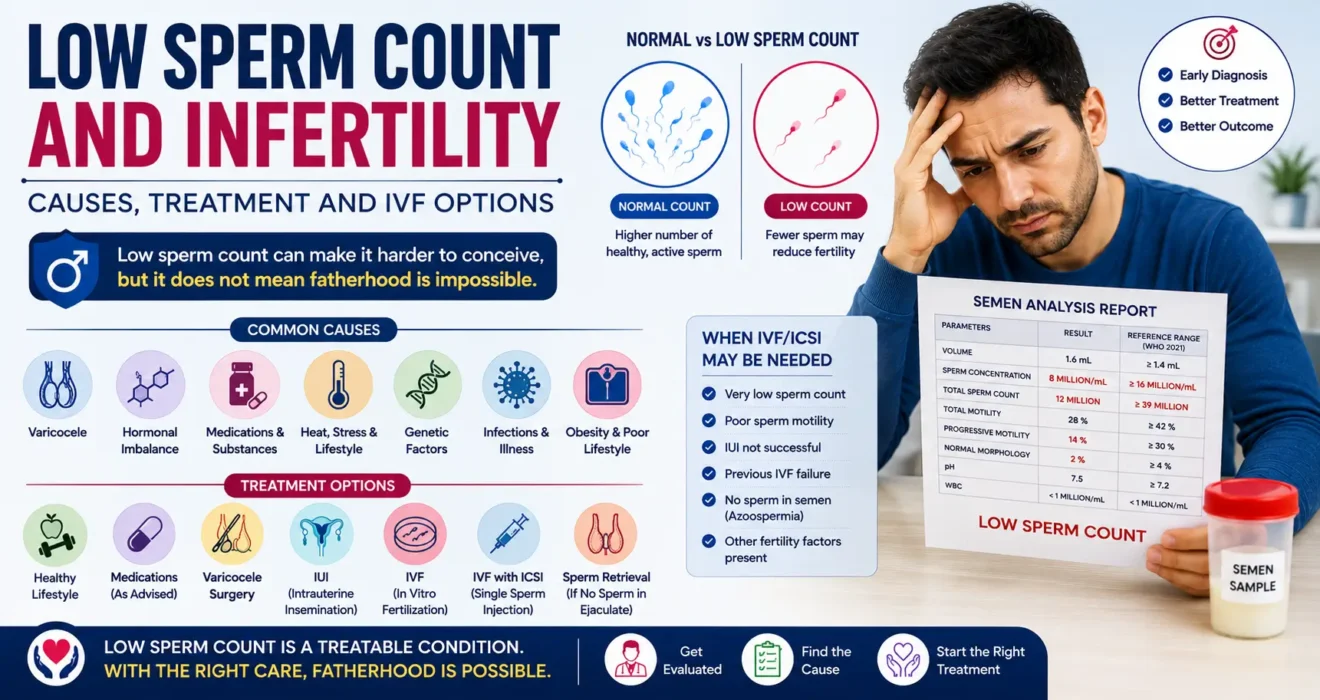
Low Sperm Count and Infertility: Causes, Treatment and When IVF or ICSI May Help
When a semen report shows a low sperm count, many couples immediately worry that pregnancy will not be possible.
It is a common concern, especially when a couple has already been trying to conceive for months.
But a low sperm count does not automatically mean that you cannot have a biological child.
Low sperm count is one of the common male fertility problems, and its effect on pregnancy depends on several factors. These include the actual sperm concentration, total number of sperm, sperm movement, sperm shape, the woman’s age and fertility, how long the couple has been trying, and whether there are other fertility problems.
In some men, sperm count improves after treating the underlying cause. Some couples may conceive naturally. Others may benefit from medicines, surgery, IUI or IVF with ICSI.
The first step is to understand what the semen report actually means.
What Is a Low Sperm Count?
Sperm count refers to the number of sperm present in the semen.
It is usually reported in two ways:
- Sperm concentration, which means the number of sperm per millilitre of semen.
- Total sperm number, which means the total number of sperm in the entire ejaculate.
The World Health Organization’s sixth edition semen laboratory manual provides standardized methods and reference limits for semen analysis. The lower reference value for sperm concentration is around 16 million sperm per millilitre, while total sperm number is around 39 million sperm per ejaculate. These are reference values based on men whose partners achieved pregnancy within a defined period. They should not be treated as a simple line between “fertile” and “infertile.”
A man can have a sperm count below the reference value and still father a child.
Similarly, a man with a sperm count within the reference range can still have fertility problems.
This is why a semen analysis should be looked at as a whole.
What Is Oligospermia?
The medical term often used for low sperm count is oligozoospermia, also called oligospermia.
It means that the concentration of sperm in the semen is lower than the expected reference range.
Oligospermia can be mild, moderate or severe depending on the results.
Some men have only a slightly reduced sperm concentration. Others may have very few sperm in the semen.
In the most severe situation, sperm may not be found in the ejaculate at all. This is called azoospermia.
These conditions are not the same and may require different treatment.
If your report says “low sperm count,” do not make a treatment decision based on that one line. Your fertility specialist should review the complete semen analysis and your medical history.
Does Low Sperm Count Mean Infertility?
No.
This is one of the most important things to understand.
A low sperm count can reduce the chances of natural conception, but it does not automatically diagnose infertility.
The AUA and ASRM male infertility guideline states that individual semen parameters, such as sperm concentration, motility and morphology, are not highly predictive of fertility on their own. The likelihood of infertility increases when several semen parameters are abnormal.
For example, a man may have:
- Low sperm count but good sperm movement.
- Normal sperm count but poor motility.
- Low sperm count and poor motility.
- Low sperm count, poor motility and abnormal morphology.
The last situation may have a greater effect on fertility than a mildly low sperm count alone.
This is why your doctor needs to look at the complete semen analysis, not just the sperm count.
Can You Get Pregnant With Low Sperm Count?
Yes.
Pregnancy can occur naturally with a low sperm count, particularly when the reduction is mild and the female partner has no major fertility problems.
However, the chance of pregnancy may be lower because fewer sperm are available to reach and fertilize the egg.
Other factors also matter.
For example, the chances may be different for:
- A 29-year-old woman with regular ovulation and a partner with mildly low sperm count.
- A 38-year-old woman with irregular ovulation and a partner with low sperm count.
- A couple with low sperm count plus blocked fallopian tubes.
- A couple with severe male factor infertility.
This is why there is no single answer to the question, “Can I get pregnant if my husband has low sperm count?”
The answer depends on both partners.
What Causes Low Sperm Count?
There are many possible causes of low sperm count.
Sometimes the cause can be identified and treated.
In other cases, no clear cause is found even after evaluation.
Some common causes include:
1. Varicocele
A varicocele is an enlargement of veins around the testicle.
It is one of the potentially treatable causes of male infertility.
A varicocele can affect sperm production and may be associated with reduced sperm concentration, motility or other abnormal semen parameters.
Not every man with a varicocele needs surgery.
A reproductive urologist can determine whether treatment is appropriate based on the man’s examination, semen analysis and fertility goals.
2. Hormonal Problems
Sperm production depends on signals from the brain, pituitary gland and testicles.
Problems involving hormones such as FSH, LH and testosterone can affect sperm production.
The AUA/ASRM guideline recommends hormonal evaluation, including FSH and testosterone, in infertile men with oligospermia or azoospermia and in men with certain sexual or physical findings.
Hormonal treatment can sometimes improve sperm production when a specific hormonal disorder is present.
3. Testicular Problems
The testicles are responsible for producing sperm.
Previous infections, injury, surgery, undescended testicles, certain genetic conditions and other testicular problems can affect sperm production.
A proper male fertility evaluation can help identify these problems.
4. Previous Surgery
Certain surgeries involving the testicles, groin, pelvis or reproductive tract can affect sperm production or sperm transport.
A history of vasectomy is also important because sperm may no longer enter the semen after the procedure.
5. Infections
Some infections can affect the male reproductive system and sperm production.
Infection or inflammation may also affect sperm movement or other semen parameters.
Treatment depends on the specific condition.
6. Medications
Some medicines can affect sperm production or sexual function.
If you are taking long-term medication and have been diagnosed with low sperm count, discuss it with your doctor before stopping anything.
Do not stop prescribed medication on your own.
7. Testosterone Treatment
This is particularly important for men trying to have a baby.
Testosterone therapy can reduce or even stop sperm production.
The AUA/ASRM guideline states that testosterone monotherapy should not be prescribed to men who are interested in current or future fertility.
If you are taking testosterone and trying to conceive, speak to a reproductive specialist before making any changes.
8. Smoking and Tobacco Use
Smoking and tobacco exposure have been associated with poorer reproductive health.
If you smoke, quitting can be an important part of improving overall health and supporting fertility treatment.
9. Alcohol and Recreational Drugs
Heavy alcohol use and recreational drug use can affect male reproductive health.
Certain substances may interfere with hormones, sperm production or sexual function.
Your doctor should know about any substance use so that fertility treatment can be planned safely.
10. Excess Heat
The testicles function best at a temperature slightly below normal body temperature.
Repeated exposure to high temperatures may affect sperm production in some men.
This can include certain occupational exposures or frequent use of hot tubs and saunas.
However, it is important not to blame one lifestyle habit for infertility without proper evaluation.
11. Obesity and Metabolic Problems
Being significantly overweight may be associated with hormonal changes and poorer semen parameters.
Improving overall metabolic health can be helpful for general health and may support reproductive health.
12. Genetic Causes
Some men with very low sperm counts or no sperm may have genetic causes.
The AUA/ASRM guideline recommends genetic testing in selected men with primary infertility and azoospermia or severe oligospermia, particularly when there are findings such as elevated FSH, testicular atrophy or suspected impaired sperm production.
Genetic testing is not required for every man with a mildly low sperm count.
Can Stress Cause Low Sperm Count?
Stress is often blamed whenever a semen report is abnormal.
The relationship is not always straightforward.
Severe stress, poor sleep and unhealthy habits can affect overall health and may indirectly affect reproductive health. However, it is not appropriate to assume that stress is the only reason for a low sperm count.
If your semen analysis is abnormal, look for medical causes as well.
Male infertility should be properly evaluated rather than dismissed as “just stress.”
Can Fever Temporarily Lower Sperm Count?
Yes.
A significant illness or high fever can temporarily affect sperm production.
This happens because sperm production takes time, and the effect of an illness may become visible on a semen analysis weeks later.
If your first semen analysis was abnormal after a significant illness or fever, your fertility specialist may recommend repeating the test after an appropriate interval.
This is one reason why a single semen analysis should not always be treated as the final answer.
Can One Semen Test Diagnose Low Sperm Count?
Not always.
Semen parameters can change from one sample to another.
The AUA/ASRM guideline recommends obtaining one or more semen analyses during the initial evaluation and notes that semen parameters can vary substantially between ejaculates. When the first analysis is abnormal, at least two analyses, ideally separated by about a month, are important for a more reliable assessment.
The ASRM laboratory guidance also emphasizes that analysis of two or more semen samples over a period of several weeks can provide a more accurate assessment.
So if your first report shows low sperm count, don’t panic.
A repeat semen analysis may provide a clearer picture.
How Is a Semen Analysis Done?
A semen analysis examines several characteristics of the semen and sperm.
The laboratory may evaluate:
Semen volume
Sperm concentration
Total sperm number
Sperm motility
Progressive motility
Sperm morphology
Other semen characteristics
The WHO semen manual provides standardized procedures for semen analysis to improve the consistency and quality of testing.
For an accurate result, the laboratory will provide instructions about abstinence and sample collection.
ASRM laboratory guidance states that semen samples for a complete analysis are generally collected after 2 to 7 days of sexual abstinence, with the exact instructions provided by the laboratory.
Follow the laboratory’s instructions carefully.
What Is a Normal Sperm Count?
The WHO 2021 reference values are useful when interpreting a semen report.
The lower reference limits include approximately:
| Semen parameter | WHO 2021 lower reference value |
|---|---|
| Semen volume | 1.4 mL |
| Sperm concentration | 16 million/mL |
| Total sperm number | 39 million/ejaculate |
| Total motility | 42% |
| Progressive motility | 30% |
| Normal morphology | 4% |
These values are reference limits, not a fertility pass-or-fail test. A man below one of these values may still father a child, while a man above them may still have difficulty conceiving.
The overall semen profile and the couple’s fertility history matter.
What Is More Important Than Sperm Count Alone?
Sperm count is important, but it is only one part of the report.
Sperm Motility
Motility tells us how well sperm move.
Sperm need appropriate movement to travel through the female reproductive tract and reach the egg.
Sperm Morphology
Morphology refers to sperm shape and structure.
A lower percentage of normally shaped sperm can be associated with reduced fertility, but morphology alone does not determine whether pregnancy is possible.
Total Motile Sperm Count
The total number of moving sperm in the ejaculate can be particularly useful when deciding whether treatments such as IUI may be appropriate.
Semen Volume
A low semen volume may sometimes point toward a problem with ejaculation, collection or the reproductive tract.
Your doctor will interpret it along with the other results.
What Is the Treatment for Low Sperm Count?
There is no single medicine that works for every man with low sperm count.
Treatment depends on the cause.
Possible approaches include:
Treating hormonal problems.
Treating certain infections when present.
Addressing medications that affect fertility.
Treating a clinically significant varicocele when appropriate.
Making suitable lifestyle changes.
Using fertility medicines in selected hormonal conditions.
Surgical treatment for certain reproductive tract problems.
IUI.
IVF.
IVF with ICSI.
Sperm retrieval procedures in selected severe male factor cases.
The AUA/ASRM guideline recommends that men with abnormal semen parameters or presumed male infertility receive evaluation by a male reproductive specialist, with further tests guided by the findings.
Can Low Sperm Count Be Treated Naturally?
You may find many online claims about foods, supplements and home remedies for increasing sperm count.
Some lifestyle changes can support general health and may help reproductive health, but there is no guaranteed food or home remedy that can fix every cause of low sperm count.
Useful steps may include:
Stop smoking.
Avoid recreational drugs.
Limit heavy alcohol use.
Maintain a healthy weight.
Exercise regularly without excessive training.
Get adequate sleep.
Manage health conditions such as diabetes or thyroid disorders.
Avoid unnecessary heat exposure.
Review medicines with your doctor.
Avoid testosterone treatment if you are trying to preserve fertility unless specifically managed by a fertility specialist.
However, lifestyle changes should not replace medical evaluation when a semen analysis is repeatedly abnormal.
Do Fertility Supplements Increase Sperm Count?
Supplements are heavily marketed for male fertility.
You may see products containing antioxidants, vitamins, minerals or other ingredients claiming to increase sperm count.
The evidence for many supplements is mixed, and they should not be treated as a guaranteed solution.
If your sperm count is low, it is more important to find out why it is low.
A man with a hormonal disorder, varicocele, genetic condition or obstruction may need a completely different treatment from a man whose semen analysis is mildly abnormal without an identifiable cause.
Speak to a fertility specialist before starting multiple supplements, particularly if you are already taking medicines.
Can Low Sperm Count Improve?
Yes, in some men.
The possibility of improvement depends on the cause.
For example, sperm production may improve after treatment of a hormonal problem or another correctable condition.
A repeat semen analysis can help determine whether sperm parameters have changed.
However, improvement is not guaranteed.
If pregnancy is the goal and the couple has already been trying for a long time, waiting for the sperm count to improve may not always be the best option.
The decision should take into account the woman’s age and fertility, the severity of male factor infertility and the couple’s treatment history.
When Is IUI Recommended for Low Sperm Count?
IUI, or intrauterine insemination, involves placing prepared sperm directly into the uterus around the time of ovulation.
It can be considered for selected couples with mild male factor infertility.
IUI may be less effective when the total number of moving sperm remains very low.
The AUA/ASRM guideline notes that when total motile sperm count is low on repeated semen analyses, IUI success rates may be reduced and IVF with ICSI may be considered.
The decision is not based on sperm count alone.
Your fertility specialist will also consider:
Woman’s age
Ovarian reserve
Ovulation
Fallopian tubes
Duration of infertility
Previous pregnancies
Previous IUI attempts
Sperm motility
Total motile sperm count
When Is IVF Recommended for Low Sperm Count?
IVF may be recommended when male factor infertility is significant or when other fertility factors make IVF a better option.
It may be considered when:
Sperm count is significantly low.
Total motile sperm count is very low.
IUI has failed.
There are additional female fertility factors.
The fallopian tubes are blocked.
The woman is older and time is an important factor.
There are multiple causes of infertility.
The couple has already undergone fertility treatment without success.
IVF allows the eggs and sperm to be brought together in the laboratory.
For some couples, this provides a better opportunity for fertilization than trying naturally or through IUI.
What Is ICSI and Why Is It Used for Low Sperm Count?
ICSI stands for intracytoplasmic sperm injection.
During ICSI, an embryologist injects a single sperm directly into a mature egg.
This can be particularly useful when there is significant male factor infertility.
For example, ICSI may be considered when:
Sperm count is extremely low.
Sperm motility is severely reduced.
Previous IVF resulted in poor or failed fertilization.
Surgically retrieved sperm are being used.
Other significant male factor problems are present.
The AUA/ASRM guideline includes IVF and ICSI among assisted reproductive treatment options for male infertility and specifically notes that IVF/ICSI may be considered when repeated total motile sperm counts are low and IUI success is expected to be reduced.
However, low sperm count does not automatically mean that ICSI is required in every case.
The treatment should be selected according to the couple’s specific fertility situation.
Can IVF Work With Very Low Sperm Count?
Yes.
Even men with very low sperm counts may have options for biological parenthood.
If sperm are present in the ejaculate, the IVF laboratory may be able to use suitable sperm for ICSI.
If sperm are not present in the ejaculate, some men may still have sperm production inside the testicles.
In selected cases, a reproductive urologist may recommend sperm retrieval procedures.
This is why a semen report showing a very low count should lead to proper evaluation, not the conclusion that biological fatherhood is impossible.
What If There Is No Sperm in the Semen?
When no sperm are found in the ejaculate, the condition is called azoospermia.
Azoospermia is different from low sperm count.
There are two broad situations:
Obstructive Azoospermia
Sperm may be produced inside the testicles but cannot reach the semen because of a blockage.
Non-Obstructive Azoospermia
The main problem is reduced or absent sperm production.
The AUA/ASRM guideline recommends evaluating men with azoospermia to distinguish obstruction from impaired sperm production using history, examination, semen volume and hormone findings.
In selected men, sperm retrieval may allow the use of sperm with IVF and ICSI.
Can Testicular Sperm Be Used for IVF?
In selected cases, yes.
When sperm cannot be found in the ejaculate, a reproductive urologist may consider procedures such as testicular sperm extraction or other sperm retrieval techniques.
If viable sperm are retrieved, they may be used with ICSI.
Whether this is appropriate depends on the cause of azoospermia and the man’s overall fertility evaluation.
This is one reason why men with severe male factor infertility should be assessed by a specialist in male reproductive health.
Does Low Sperm Count Affect the Baby?
Male infertility can sometimes be associated with underlying genetic or medical conditions.
This does not mean that every man with low sperm count has a genetic problem.
However, men with severe oligospermia or azoospermia may require additional evaluation.
The AUA/ASRM guideline recommends specific genetic testing for selected men with severe oligospermia or azoospermia, depending on factors such as FSH, testicular size and suspected cause of impaired sperm production.
If genetic testing is recommended, your doctor can explain what the result means for fertility treatment and the potential implications for the child.
Should Both Partners Be Tested?
Yes.
Male infertility should not be treated as a problem that belongs only to the husband.
The AUA/ASRM guideline recommends concurrent evaluation of both partners.
The female partner’s age is particularly important when planning fertility treatment.
For example, a couple may have mild male factor infertility, but if the woman is 38 or 39, delaying treatment for a long period while trying to improve the sperm count may not be the best approach.
On the other hand, a younger couple with mild male factor infertility may have more time to consider less invasive options.
The right plan depends on both partners.
How Long Should You Try Naturally With Low Sperm Count?
There is no single waiting period that applies to every couple.
If the sperm count is only mildly reduced and the female partner has no major fertility problems, your doctor may discuss trying naturally for some time.
But if the sperm count is very low, there are multiple abnormal semen parameters or the woman is older, it may make sense to move toward fertility treatment sooner.
A known male fertility problem is a reason for fertility evaluation rather than simply waiting for a standard 12-month period.
ASRM recommends fertility evaluation at 12 months for women under 35 and after 6 months for women aged 35 or older, with earlier evaluation when there is a known condition associated with infertility.
Can Low Sperm Count Be Caused by Varicocele?
Yes.
A varicocele can be associated with impaired sperm production.
If a varicocele is found during a male fertility evaluation, the doctor will determine whether it is clinically significant and whether treatment may help.
Not every varicocele requires surgery.
The decision depends on the man’s examination, semen analysis, symptoms and fertility goals.
Can Testosterone Increase Sperm Count?
This is a very common misunderstanding.
Taking testosterone is not a fertility treatment for men trying to have a baby.
External testosterone can suppress the body’s natural signals needed for sperm production and may significantly reduce sperm production.
The AUA/ASRM guideline specifically states that testosterone monotherapy should not be prescribed to men who want current or future fertility.
If you have low testosterone and are also trying to conceive, tell your doctor.
There are fertility-focused approaches for selected men with hormonal problems, but they should be prescribed after proper evaluation.
What Should Men Do Before a Repeat Semen Analysis?
Follow the instructions provided by your laboratory.
Usually, the laboratory will ask you to maintain a specified period of sexual abstinence before the sample.
The entire ejaculate should be collected according to the laboratory’s instructions.
Tell the laboratory or doctor about:
Recent fever
Significant illness
Medicines
Testosterone use
Previous surgery
Difficulty collecting the complete sample
Any unusual circumstances around the collection
These details can help the doctor interpret the result correctly.
When Should a Man See a Male Fertility Specialist?
Do not wait too long if the semen analysis is abnormal.
A male reproductive specialist or reproductive urologist can evaluate:
Sperm count
Sperm motility
Sperm morphology
Testicular size
Varicocele
Hormone levels
Previous infections
Previous surgery
Medication use
Testosterone or steroid use
Genetic factors
Sexual function
Ejaculation problems
The AUA/ASRM guideline recommends specialist evaluation for men with one or more abnormal semen parameters or presumed male infertility.
Low Sperm Count and IVF. What Should Couples Expect?
If IVF is recommended because of male factor infertility, the treatment usually involves ovarian stimulation for the female partner, egg retrieval and fertilization in the laboratory.
When sperm count is significantly low, ICSI may be used to assist fertilization.
The number of eggs retrieved depends mainly on the woman’s ovarian reserve and response to stimulation.
The number and quality of embryos that develop depend on both egg and sperm factors as well as other laboratory and biological factors.
This is why an IVF consultation should cover both partners.
It is not enough to say, “The sperm count is low, so we need IVF.”
The fertility specialist should explain:
How low the sperm count is.
Whether motility is also affected.
Whether IUI is reasonable.
Whether IVF is more suitable.
Whether ICSI is likely to be recommended.
Whether sperm retrieval may be needed.
Whether genetic testing is indicated.
How the woman’s age and ovarian reserve affect the treatment plan.
Low Sperm Count Does Not Mean You Are Out of Options
A low sperm count can be upsetting.
Some men feel embarrassed or blame themselves when they receive an abnormal semen report.
There is no reason to feel ashamed.
Male factor infertility is a medical issue, just like many other fertility conditions.
In fact, male factors contribute to infertility in a substantial proportion of couples. The AUA/ASRM guideline notes that male factors are involved in approximately half of infertile couples, either alone or together with female factors.
The important thing is to find out what is causing the problem and what options are available.
In many cases, couples have several possible paths toward pregnancy.
Conclusion
Low sperm count does not mean that fatherhood is impossible.
It means that there may be fewer sperm available to fertilize the egg, and the effect on fertility depends on how low the count is and whether motility, morphology or other semen parameters are also abnormal.
The first step is a proper semen analysis and, when abnormal, usually a repeat test.
The next step is finding out why the sperm count is low.
Sometimes the problem can be treated. In other cases, assisted reproductive treatment may provide the best option.
For some couples, natural conception may still be possible.
For selected couples, IUI may be appropriate.
When sperm numbers are significantly low, IVF with ICSI can allow a single suitable sperm to be used to fertilize an egg.
Even men with very severe male factor infertility may have options involving sperm retrieval and ICSI, depending on the underlying cause.
Most importantly, do not look at the sperm count in isolation.
Your fertility is a couple’s issue, not only a man’s issue or a woman’s issue. Both partners should be assessed so that treatment is chosen according to the actual cause of infertility.
If you have received a semen report showing low sperm count, do not lose hope and do not start random supplements without knowing the cause.
Get the report reviewed by a fertility specialist or male reproductive specialist and understand what the result means for your chances of natural conception, IUI or IVF.
About Dr. Shipra Singla
Dr. Shipra Singla is an infertility and IVF specialist helping couples understand the causes of infertility and choose fertility treatment according to their individual needs.
If you and your partner have been trying to conceive and the semen report shows low sperm count, poor sperm motility, abnormal morphology or severe male factor infertility, a fertility consultation can help you understand the available treatment options, including IUI, IVF and ICSI.
A low sperm count is a fertility problem. It is not the end of your chances of becoming parents.
Frequently Asked Questions About Low Sperm Count
What is considered a low sperm count?
The WHO 2021 lower reference value for sperm concentration is approximately 16 million sperm per millilitre. However, this is a reference value and not a simple definition of whether a man is fertile or infertile.
Can a man with low sperm count father a child?
Yes. Mild or moderate low sperm count does not necessarily prevent natural pregnancy. The couple’s overall fertility picture matters.
Can low sperm count be cured?
It depends on the cause. Some causes can be treated, while others cannot be completely reversed. Fertility treatments such as IUI, IVF and ICSI can help when natural conception is difficult.
Can low sperm count improve naturally?
It may improve in some men, particularly when a temporary or correctable factor is involved. However, there is no guaranteed natural treatment for every case.
How long does it take for sperm count to improve?
Sperm production takes time, so changes in sperm parameters are not usually seen immediately. Your doctor can advise when a repeat semen analysis is appropriate based on the cause and treatment.
Is low sperm count the same as azoospermia?
No. Low sperm count means sperm are present but fewer than expected. Azoospermia means sperm are not found in the ejaculate.
Can IVF work with low sperm count?
Yes. IVF can be used for male factor infertility, and ICSI may be recommended when sperm count or other semen parameters are significantly impaired.
Is ICSI better than IVF for low sperm count?
ICSI is a technique used during IVF in which a single sperm is injected into an egg. It can be useful for significant male factor infertility. Whether it is needed depends on the semen results and treatment history.
Can IUI work with low sperm count?
It can work in selected couples, particularly when the total motile sperm count is adequate. When repeated total motile sperm counts are very low, IUI success may be reduced and IVF/ICSI may be considered.
Should the semen test be repeated?
If the first semen analysis is abnormal, it is often appropriate to repeat it because semen parameters can vary between ejaculates. The AUA/ASRM guideline recommends at least two analyses when the first is abnormal, ideally separated by about a month.
Does low sperm count mean low testosterone?
Not necessarily. Sperm production and testosterone production are related but are not the same thing. Some men with low sperm counts have normal testosterone levels.
Can testosterone injections cause low sperm count?
Yes. Testosterone therapy can suppress sperm production and should not be used as monotherapy in men who want current or future fertility.
Can varicocele cause low sperm count?
Yes. A varicocele can affect sperm production in some men and may be a treatable cause of male infertility.
Can a man with very low sperm count use his own sperm for IVF?
In many cases, yes. Depending on the situation, sperm from the ejaculate may be used for ICSI. If sperm cannot be found in the semen, sperm retrieval may sometimes be possible.
What if there is no sperm in the semen?
Azoospermia requires further evaluation to determine whether sperm production is impaired or sperm are blocked from reaching the ejaculate. In selected cases, sperm retrieval combined with IVF and ICSI may be possible.
Does low sperm count increase the risk of infertility for the couple?
Yes, a low sperm count can reduce the probability of natural conception, especially when other semen parameters are also abnormal. But no single semen parameter can determine fertility by itself.
Should the wife also have fertility tests if the husband has low sperm count?
Yes. Both partners should be evaluated because infertility can involve male factors, female factors or both.